sábado, 12 de fevereiro de 2011

Speech: But westward, look, the land is bright (1941-04-27)

Churchill speech, at BBC, 27th April 1941.


I was asked last week whether I was aware of some uneasiness which it was said existed in the country on account of the gravity, as it was described, of the war situation. So I thought it would be a good thing to go and see for myself what this 'uneasiness' amounted to, and I went to some of our great cities and seaports which had been most heavily bombed, and to some of the places where the poorest people had got it worst. I have come back not only reassured, but refreshed. To leave the offices in Whitehall with their ceaseless hum of activity and stress, and go out to the front, by which I mean the streets and wharves of London or Liverpool, Manchester, Cardiff, Swansea or Bristol, is like going out of a hothouse on to the bridge of a fighting ship. It is a tonic which I should recommend any who are suffering from fretfulness to take in strong doses when they have need of it.

It is quite true that I have seen many painful scenes of havoc, and of fine buildings and acres of cottage homes blasted into rubble-heaps of ruin. But it is just in those very places where the malice of the savage enemy has done its worst, and where the ordeal of the men, women and children has been most severe, that I found their morale most high and splendid. Indeed, I felt encompassed by an exaltation of spirit in the people which seemed to lift mankind and its troubles above the level of material facts into that joyous serenity we think belongs to a better world than this.

Of their kindness to me I cannot speak, because I have never sought it or dreamed of it, and can never deserve it. I can only assure you that I and my colleagues, or comrades rather - for that is what they are - will toil with every scrap of life and strength, according to the lights that are granted to us, not to fail these people or be wholly unworthy of their faithful and generous regard. The British nation is stirred and moved as it has never been at any time in its long, eventful, famous history, and it is no hackneyed trope of speech to say that they mean to conquer or to die.

What a triumph the life of these battered cities is, over the worst that fire and bomb can do. What a vindication of the civilized and decent way of living we have been trying to work for and work towards in our Island. What a proof of the virtues of free institutions. What a test of the quality of our local authorities, and of institutions and customs and societies so steadily built. This ordeal by fire has even in a certain sense exhilarated the manhood and womanhood of Britain. The sublime but also terrible and sombre experiences and emotions of the battlefield which for centuries had been reserved for the soldiers and sailors, are now shared, for good or ill, by the entire population. All are proud to be under the fire of the enemy. Old men, little children, the crippled veterans of former wars, aged women, the ordinary hard-pressed citizen or subject of the King, as he likes to call himself, the sturdy workmen who swing the hammers or load the ships; skillful craftsmen; the members of every kind of ARP Service, are proud to feel that they stand in the line together with our fighting men, when one of the greatest of causes is being fought out, as fought out it will be, to the end. This is indeed the grand heroic period of our history, and the light of glory shines on all.

You may imagine how deeply I feel my own responsibility to all these people; my responsibility to bear my part in bringing them safely out of this long, stern, scowling valley through which we are marching, and not to demand from them the sacrifices and exertions in vain.

I have thought in this difficult period, when so much fighting and so many critical and complicated manouvres are going on, that it is above all things important that our policy and conduct should be upon the highest level, and that honour should be our guide. Very few people realize how small were the forces with which General Wavell, that fine Commander whom we cheered in good days and will hack through bad - how small were the forces which took the bulk of the Italian masses in Libya prisoners. In none of his successive victories could General Wavell maintain in the desert or bring into action more than two divisions, or about 30,000 men. When we reached Benghazi, and what was left of Mussolini's legions scurried back along the dusty road to Tripoli, a call was made upon us which we could not resist. Let me tell you about that call.

You will remember how in November the Italian Dictator fell upon the unoffending Greeks, and without reason and without warning invaded their country, and how the Greek nation, reviving their classic fame, hurled his armies back at the double-quick. Meanwhile Hitler, who had been creeping and worming his way steadily forward, doping and poisoning and pinioning, one after the other Hungary, Rumania and Bulgaria, suddenly made it clear that he would come to the rescue of his fellow-criminal. The lack of unity among the Balkan States had enabled him to build up a mighty army in their midst. While nearly all the Greek troops were busy beating the Italians, the tremendous German military machine suddenly towered up on their other frontier. In their mortal peril the Greeks turned to us for succour. Strained as were our own resources, we could not say them nay. By solemn guarantee given before the war, Great Britain had promised them her help. They declared they would fight for their native soil even if neither of their neighbours made common cause with them, and even if we left them to their fate. But we could not do that. There are rules against that kind of thing; and to break those rules would be fatal to the honour of the British Empire, without which we could neither hope nor deserve to win this hard war. Military defeat or miscalculation can be redeemed. The fortunes of war are fickle and changing. But an act of shame would deprive us of the respect which we now enjoy throughout the world, and this would sap the vitals of our strength.

During the last year we have gained by our bearing and conduct a potent hold upon the sentiments of the people of the United States. Never, never in our history, have we been held in such admiration and regard across the Atlantic Ocean. In that great Republic, now in much travail and stress of soul, it is customary to use all the many valid, solid arguments about American interests and American safety, which depend upon the destruction of Hitler and his foul gang and even fouler doctrines. But in the long run - believe me, for I know - the action of the United States will be dictated, not by methodical calculations of profit and loss, but by moral sentiment, and by that gleaming flash of resolve which lifts the hearts of men and nations, and springs from the spiritual foundations of human life itself.

We, for our part, were of course bound to hearken to the Greek appeal to the utmost limit of our strength. We put the case to the Dominions of Australia and New Zealand, and their Governments, without in any way ignoring the hazards, told us that they felt the same as we did. So an important part of the moibile portion of the Army of the Nile was sent to Greece in fulfilment of our pledge. It happened that the divisions available and best suited to this task were from New Zealand and Australia, and that only about half the troops who took part in this dangerous expedition came from the Mother Country. I see the German propaganda is trying to make bad blood between us and Australia by making out that we have used them to do what we would not have asked of the British Army. I shall leave it to Australia to deal with that taunt.

Let us see what has happened. We knew, of course, that the forces we could send to Greece would not by themselves alone be sumcient to stem the German tide of invasion. But there was a very real hope that the neighbours of Greece would by our intervention be drawn to stand in line together with her while time remained. How nearly that came off will be known some day. The tragedy of Yugoslavia has been that these brave people had a government who hoped to purchase an ignoble immunity by submission to the Nazi will. Thus when at last the people of Yugoslovia found out where they were being taken, and rose in one spontaneous surge of revolt, they saved the soul and future of their country: but it was already too late to save its territory. They had no time to mobilize their armies. They were struck down by the ruthless and highly mechanized Hun before they could even bring their armies into the field. Great disasters have occurred in the Balkans. Yugoslavia has been beaten down. Only in the mountains can she continue her resistance. The Greeks have been overwhelmed. Their victorious Albanian army has been cut off and forced to surrender, and it has been left to the Anzacs and their British comrades to fight their way back to the sea, leaving their mark on all who hindered them.

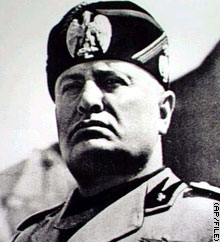
I turn aside from the stony path we have to tread, to indulge a moment of lighter relief. I dare say you have read in the newspapers that, by a special proclamation, the Italian Dictator has congratulated the Italian army in Albania on the glorious laurels they have gained by their victory over the Greeks. Here surely is the world's record in the domain of the ridiculous and the contemptible. This whipped jackal, Mussolini, who to save his own skin has made all Italy a vassal state of Hitler's Empire, comes frisking up at the side of the German tiger with yelpings not only of appetite - that can be understood - but even of triumph. Different things strike different people in different ways. But I am sure there are a great many millions in the British Empire and in the United States, who will find a new object in life in making sure that we come to the final reckoning this absurd impostor will be abandoned to public justice and universal scorn.

While these grievous events were taking place in the Balkan Peninsula and in Greece, our forces in Libya have sustained a vexatious and damaging defeat. The Germans advanced sooner and in greater strength than we or our Generals expected. The bulk of our armoured troops, which had played such a decisive part in beating the Italians, had to be refitted, and the single armoured brigade which had been judged sufficient to hold the frontier till about the middle of May was worsted and its vehicles largely destroyed by a somewhat stronger German armoured force. Our infantry, which had not exceeded one division, had to fall back upon the very large Imperial armies that have been assembled and can be nourished and maintained in the fertile delta of the Nile.

Tobruk - the fortress of Tobruk - which Aanks any German advance on Egypt, we hold strongly. There we have repulsed many attacks, causing the enemy heavy losses and taking many prisoners. That is how the matter stands in Egypt and on the Libyan front.

We must now expect the war in the Mediterranean on the sea, in the desert, and above all in the air, to become very fierce, varied and widespread. We had cleared the Italians out of Cyrenaica, and it now lies with us to purge that province of the Germans. That will be a harder task, and we cannot expect to do it at once. You know I never try to make out that defeats are victories. I have never underrated the German as a warrior. Indeed I told you a month ago that the swift, unbroken course of victories which we had gained over the Italians could not possibly continue, and that misfortunes must be expected. There is only one thing certain about war, that it is full of disappointments and also full of mistakes. It remains to be seen, however, whether it is the Germans who have made the mistake in trampling down the Balkan States and in making a river of blood and hate between themselves and the Greek and Yugoslav peoples. It remains also to be seen whether they have made a mistake in their attempt to invade Egypt with the forces and means of supply which they have now got. Taught by experience, I make it a rule not to prophesy about battles which have yet to be fought out. This, however, I will venture to say, that I should be very sorry to see the tasks of the combatants in the Middle East exchanged, and that General Wavell's armies should be in the position of the German invaders. That is only a personal opinion, and I can well understand you may take a different view. It is certain that fresh dangers besides those which threaten Egypt may come upon us in the Mediterranean. The war may spread to Spain and Morocco. It may spread eastward to Turkey and Russia. The Huns may lay their hands for a time upon the granaries of the Ukraine and the oil-wells of the Caucasus. They may dominate the Black Sea. They may dominate the Caspian. Who can tell? We shall do our best to meet them and fight them wherever they go. But there is one thing which is certain. There is one thing which rises out of the vast welter which is sure and solid, and which no one in his senses can mistake. Hitler cannot find safety from avenging justice in the East, in the Middle East, or in the Far East. In order to win this war, he must either conquer this Island by invasion, or he must cut the ocean life-line which joins us to the United States.

Let us look into these alternatives, if you will bear with me for a few minutes longer. When I spoke to you last, early in February, many people believed the Nazi boastings that the invasion of Britain was about to begin. It has not begun yet, and with every week that passes we grow stronger on the sea, in the air, and in the numbers, quality, training and equipment of the great Armies that now guard our Island. When I compare the position at home as it is today with what it was in the summer of last year, even after making allowance for a much more elaborate mechanical preparation on the part of the enemy, I feel that we have very much to be thankful for, and I believe that provided our exertions and our vigilance are not relaxed even for a moment, we may be confident that we shall give a very good account of ourselves. More than that it would be boastful to say. Less than that it would be foolish to believe.

But how about our life-line across the Atlantic? What is to happen if so many ofour merchant ships are sunk that we cannot bring in the food we need to nourish our brave people? What if the supplies ofwar materials and war weapons which the United States are seeking to send us in such enormous quantities should in large part be sunk on the way? What is to happen then? In February, as you may remember, that bad man in one of his raving outbursts threatened us with a terrifying increase in the numbers and activities of his U-boats and in his air-attack - not only on our Island but, thanks to his use of French and Norwegian harbours, and thanks to the denial to us of the Irish bases - upon our shipping far out into the Atlantic. We have taken and are taking all possible measures to meet this deadly attack, and we are now fighting against it with might and main. That is what is called the Battle of the Atlantic, which in order to survive we have got to win on salt water just as decisively as we had to win the Battle of Britain last August and September in the air.

Wonderful exertions have been made by our Navy and Air Force; by the hundreds of mine-sweeping vessels which with their marvellous appliances keep our ports clear in spite of all the enemy can do; by the men who build and repair our immense fleets of merchant ships; by the men who load and unload them; and need I say by the officers and men of the Merchant Navy who go out in all weathers and in the teeth of all dangers to fight for the life of their native land and for a cause they comprehend and serve. Still, when you think how easy it is to sink ships at sea and how hard it is to build them and protect them, and when you remember that we have never less than two thousand ships afloat and three or four hundred in the danger zone; when you think of the great armies we are maintaining and reinforcing in the East, and of the worldwide traffic we have to carry on - when you remember all this, can you wonder that it is the Battle of the Atlantic which holds the first place in the thoughts of those upon whom rests the responsibility for procuring the victory?

It was therefore with indescribable relief that I learned of the tremendous decisions lately taken by the President and people of the United States. The American Fleet and flying boats have been ordered to patrol the wide waters of the Western Hemisphere, and to warn the peaceful shipping of all nations outside the combat zone of the presence of lurking U-boats or raiding cruisers belonging to the two aggressor nations. We British shall therefore be able to concentrate our protecting forces far more upon the routes nearer home, and to take a far heavier toll of the U-boats there. I have felt for some time that something like this was bound to happen. The President and Congress of the United States, having newly fortified themselves by contact with their electors, have solemnly pledged their aid to Britain in this war because they deem our cause just, and because they know their own interests and safety would be endangered if we were destroyed. They are taxing themselves heavily. They have passed great legislation. They have turned a large part of their gigantic industry to making the munitions which we need. They have even given us or lent us valuable weapons of their own. I could not believe that they would allow the high purposes to which they have set themselves to be frustrated and the products of their skill and labour sunk to the bottom of the sea. U-boat warfare as conducted by Germany is entirely contrary to international agreements freely subscribed to by Germany only a few years ago. There is no effective blockade, but only a merciless murder and marauding over wide, indiscriminate areas utterly beyond the control of the German seapower. When I said ten weeks ago: 'Give us the tools and we will finish the job', I meant, give them to us: put them within our reach - and that is what it now seems the Americans are going to do. And that is why I feel a very strong conviction that though the Battle of the Atlantic be will be long and hard, and its issue is by no means yet determined, it has entered upon a more grim but at the same time a far more favourable phase. When you come to think of it, the United States are very closely bound up with us now, and have engaged themselves deeply in giving us moral, material, and, within the limits I have mentioned, naval support.

It is worth while therefore to take a look on both sicies of the ocean at the forces which are facing each other in this awful struggle, from which there can be no drawing back. No prudent and far-seeing man can doubt that the eventual and total defeat of Hitler and Mussolini is certain, in view of the respective declared resolves of the British and American democracies. There are less than seventy million malignant Huns - some of whom are curable and others killable - many of whom are already engaged in holding down Austrians, Czechs, Poles, French, srnd the many other ancient races they now bully and pillage. The peoples of the British Empire and of the United States number nearly two hundred millions in their homelands and in the British Dominions alone. They possess the unchallengeable command ofthe oceans, and will soon obtain decisive superiority in the air. They have more wealth, more technical resources, and they make more steel, than the whole of the rest of the world put together. They are determined that the cause of freedom shall not be trampled down, nor the tide of world progress turned backwards, by the criminal Dictators.

While therefore we naturally view with sorrow and anxiety much that is happening in Europe and in Africa, and may happen in Asia, we must not lose our sense of proportion and thus become discouraged or alarmed. When we face with a steady eye the dimculties which lie before us, we may derive new confidence from remembering those we have already overcome. Nothing that is happening now is comparable in gravity with the dangers through which we passed last year. Nothing that can happen in the East is comparable with what is happening in the West.
Last time I spoke to you I quoted the lilles of Longfellow which President Roosevelt had written out for me in his own hand. I have some other lines which are less well known but which seem apt and appropriate to our fortunes tonight, and I believe they will be so judged wherever the English language is spoken or the flag of freedom flies:

For while the tired waves, vainly breaking,
Seem here no painful inch to gain,
Far back, through creeks and inlets making,
Comes silent, flooding in, the main.

And not by easlern windows only,
When daylight comes, comes in the light;
ln front the sun climbs slow, how slowly,
But westward, look, the land is bright.

sábado, 1 de janeiro de 2011

Russian front: new tanks

I had started to read some weeks ago, the book "War without garlands", from Robert Kershaw. It's a great book, for sure. With a german view of the battle, the author brings a new look about the whole war.

Following I quote some nice parts about the T-34 soviet tank and how the germans had defied this weapon.

 An unpleasant surprise for the supremely confident Panzer troops was the quality of some of the Soviet equipments they soon faced.

German PAK 38 50 mm (Wikipedia)

On the second day of the campaign, in the 6th Panzer Division sector, 12 German supply trucks were knocked out, one after the other, by a solitary unidentified Soviet heavy tank. The vehicle sat astride the road south of the River Dubysa near Rossieny. Further beyond, two German combat teams had already been destroyed. Rutted muddy approaches and a nearby forest infested with bands of stay-behind Russian infantry negated option to bypass. The russian tank had to be eliminated. A battery of medium 50mm German anti-tank guns was sent forward to force the route.
The guns were skifully manhandled by their crews through close terrain up to within 600m of their intended target. Three red-hot tracer-based shells spat out at 823m/sec, smacking into the tank with rapid and resounding 'plunks' one after the other. At first there was cheering but the crews became concerned as these and another five rounds spun majestically into the air as they ricocheteated off the armour of the unknow tank type. Its turret came to life and remorselessly traversed in their direction. Within minutes the entire baterry was silenced by a lethal succession of 76mm HE shells that tore into them. Casualties were heavy.

Flak 88mm

Meanwhile a well-camouflaged 88mm Flak gun carefully crept foward, slowly towed by its half-tractor, winding its way among cover provided by the 12 burnt-out German trucks strewn about the road. It got within 900m of the Soviet tank before a further 76mm round spat out, spinning the gun into a roadside ditch. The crew, caught in the act of manhandling the trails into position, were mown down by a swathe of coaxial machine gun fire. Nothing moved until nightfall when, under the cover of dakness, it was safe enough to recover the dead and wounded and salvage some of the knocked-out equipments.
An inconclusive raid was mounted that night by assault engineers who managed to attach two demolition charges onto this sill, as yet, unidentified tank type. Both charges exploded, but retaliatory turret fire confirmed the tank was still in action. Three atacks had failed. Dive-bomber support was requested but not avaible. A fourth attack plan was developed involving a further 88mm Flak gun, supported this time by light Panzers which were to feint and provide covering fire in a co-ordinated daylight operation.
Panzers, utilising tree cover, skirmished forward and began to engage the solitary tank from three directions. This confused the Russian tank which, in attempting to duel with these fast-moving and fleeting targets, was struck in the rear by the newly positioned 88mm Flak gun. Three rounds bore into the hull at over 1,000m/sec. The turret trversed rearward and stopped. There was no sign of an explosion or fire soa further four rounds smashed remorselessly into the apparently helpless target. Spent ricochets spun white-hot to the ground followed by the metallic signatures of skyward. With the engagement over at last, the nearest German troops moved forward to inspect their victim.
Excited and chaterring they clambered aboard the armoured colossus. They had never sen such tank before. Suddenly the turret began to rotate again and the soldiers frantically scattered. Two enginners had the presence of mind to drop two stick grenades into the interior of the tank, through one of the holes pierced by the shot at the base of the turret. Muffled explosions followed and the turret hatch clattered open with an exhalation of smoke. Peering inside the assalut engineers could just make out the mutilated remains of the crew. This single tank had blocked forward replenishment to the 6th Panzer Division vanguard for 48 hours. Only two 88mm shells actually penetrated the armour; five others had gouged deep dents. Eight carbonised blue marks were the only indication of 50mm gun impacts. There was no trace at all of the supporting Panzers strikes, many of which had clearly been seen to hit.
[...]

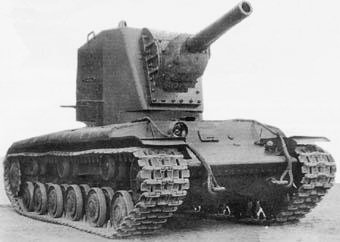
This was the KV-1 (Klim Voroshilov) which mounted a 76.2mm gun. Its sister variant, the KV-2, although more unwieldly, did have a 15cm gun.

KV-1

KV-2
 [...]

The appearance of the 34-ton T-34 caused much consternation to the German Panzerwaffe. Developed in relative secrecy six years before, its 76mm gus was the largest armament (apart from the 15cm KV-2) then mounted. Its 60% sloping armour was revolutionary in terms of the increased armoured protection it offered against flat trajectory anti-tank shells, which often simply ricocheted off. Josef Deck, a German artilleryman with Regiment 71 in the central sector, complained that the 37mm standart anti-tank fire 'bounced off them like peas'. Adapting the American Christie suspension system, the T-34, with extra-wide tracks and a powerfull lightweight diesel engine, possessed an enormous relative power-to-weight ratio, conferring superior mobility on the Russian vehicles. Is was to prove the outstanding tank design of the war, and was a formidable adversary, even in the hand of a novice. [...]
Oqueka's battery commander, Oberleutnant Rossman, had a similar experience with the "grey-green colossus", finishing they off firing at the tracks with 20mm cannon.
They moved foward curiously to examine the results of their handiwork and discovered that, apart from cut caterpillar treads and damage to dive and sprocket wheels, there was nothing to explain the abrupt abandonment of the tanks. 'Not until the prisioners were questioned did the riddle become clear', explained Oqueka. The answer lay in the resonant din produced by multiple 20mm strikes os cast steel turrets, which had the effect of transforming them into 'huge bellls'.
'Continuous explosions on the turret had produced a hellish noise which had grown louder from explosion to explosion. The sound had swollen beyond the realms of tolerance and had virtually driven the crews insane'
Oqueka recalled the example of executions of indirected criminals in ancient China. Hapless individuals were incarcerated inside a huge bell which was hammered outside until the unfortunate victim expired. [...]
Kershaw, Robert. War without garlands. Pag. 175-177, 346-347.


quinta-feira, 30 de dezembro de 2010

sábado, 18 de setembro de 2010

Wy study Winston Churchill?

Quoting the Churchill Centre:

Why study Winston Churchill? What makes him relevant in the 21st century? Members of the Churchill family and the Churchill Centre answer the question in this video short.


domingo, 5 de setembro de 2010

Triumph des Willens

John S. D. Eisenhower ponders about Hitler's isolation and the "Triumph des Willens", after the assassination attempt of July 20.
[...] Except for his left arm, his slight injuries had healed by now; but he remained weak. He was confined to bed for most of the day by order of his personal physician, leaving it only occasionally to receive important visitors.
This confinement was the culmination of Hitler's progressive removal from a life that had once almost completely public. The withdraw actually began soon after the coming of war. After 1940 he made fewer and fewer appearances, leaving the speechmaking largely to Josef Goebbels. Preoccupied with the details of the conduct of military operations, he saw only the highest officials. Now, at Rastenburg, the process was complete. The Wolf did not leave his lair, and his life had narrowed down to the manipulation of symbols on a map, representations that progressively were less associated with units made up of human beings. Reality was rapidly being replaced by a sort of dream.
[...]
After the attempt on Hitler's life on July 20, of course, the situation was greatly exacerbated. Now bot the field marshals or the commanding generals of the Heer of the officers of the General Staff Corps could be entrusted with strategic operations. What had been dislike of the officer class turned into bitter distrust. Only to associates of proven loyalty such as Jodl and Keitel were Hitler's plans revealed, and to them only gradually.
By the summer of 1944 many surviving German officers of the highest rank had come to believe, or had convinced themselves, that Hitler possessed keen insight into the nature of war and could produce strategic concepts of striking originality. This was, of course, Hitler's view of himself: "A war leader," he said after his Russian victories, "is what I am against my own will. If I apply my mind to military problems, that's because for the moment I know that nobody would succeed better at this than I can".
The fact is that Hitler had a unusual memory, and because of his extensive reading and continual discussion with experts, he had acquired a fund of knowledge in specialized areas often superior to that of the majority of the senior staff officers. Even Generaloberst Heinz Guderian, one of the few who disagreed openly with Hitler on occasion and survived, continued to respect Hitler's military learning.
But it is one thing acquire a fund of information; it is another to apply that tool with common sense, reason, and discipline.  Herein lay the basic cleavage between Hitler and the members of the professional German Officer Corps. The qualities of hardheaded reason and thoroughness that the General Staff embodied carried little weight with Hitler. The quality most important to a leader, at least to the top of a great nation, was the mystical quality that he termed "fanaticism."
The conception Hitler had of "fanaticism" has little to do with the English or American definition of the word. Americans would agree that Hitler was a fanatic, but they would not understand what he meant by calling himself so. To Hitler a fanatic was a man who believed in the wonder-working providences of his own will. And the fascinating feature of Hitler's personality, the quality that converted skeptics into followers, was precisely power of will. To this his associates attributed the rise and the eventual triumph of Nazism out of obscurity and disgrace [...]
What made Hitler a "revolutionary" in his thinking was a perversion of German romantic idealism, e. g.: man discovers the truth of existence whenever he molds the outside world into conformity with an idea. To live most deeply is to overcome obstacles, to give shape to the recalcitrant world in which one finds oneself.
This during his rise to power Hitler set himself and his followers objectives that seemed impossible to realize, believing that while premeditated calculations would immediately jump the rails, the impossible could always be reached through the energies generated on one's own side and the general paralysis on the enemy's. Hitler held that we must make a dream work - then it will be as real as a panther tank.
When Hitler's obsession with the "primacy of will" is taken into consideration, many of his attitudes and actions can be better understood. It accounts for his supreme confidence in himself as a military leader and for two of the chief tenets in his military doctrine: (1) "Attack is the best defense," a notion that he praised Clausewitz for expressing, and (2) "Troops should never be made to feel uncertain by withdrawal." If only the will to resist is flexible, most requests for withdrawal are superfluous. The German military found that preparing a precautionary defensive line behind the line of present contact was usually impossible, for Hitler normally refused to allow any commander to look over his shoulder. Commanders were defeatists unless the looked for new forward positions to which to advance.
Einsenhower, John S. D.  The battle of the bulge. Pages 106-109.

quarta-feira, 1 de setembro de 2010

Coalition II

John S. D. Eisenhower cites Pogue:

A word of caution is necessary for the reader who may be unduly impressed by the accounts of controversy and difference of opinion which arose between commanders of the same nationality, officers of different nationalities, and heads of government... When the discussions of the participants in Allied conferences are seen in cold print, without the benefit of the smile which softened a strong argument or the wry shrug which made clear that the debate was for the record, and when there is no transcript of the friendly conversation which followed the official conference, the reader may get the impression that constant argument and heated controversy marked most meetings between  Allied leaders... It is inevitable that a study of such discussions will emphasize the disagreements and spell out the problems in reaching accords. The numerous basic decisions which were reached with only minor debate attract less attention...
The success of ... an alliance is to be judged ... not by the amount of heat which may be engendered between the powers in their attempts to find a course of action which will most nearly preserve their individual aims while gaining a common goal, but rather by the degree to which the powers, while frankly working on a basis of self-interest, manage to achieve the one aim for which their forces were brought together. On that basis the Western Powers forged a unit seldom, if ever, achieved in the history of grand alliances. Their commanders, while striving to preserve national identity and gain individual honors for their forces, still waged a victorious war.
Eisenhower, John S. D. The battle of the Bulge. Page 99.

Coalition

About the coalitions, John S. D. Eisenhower says:

Yet in the case of High Command in France, another factor had to be given careful consideration - feelings of national pride. Pride in country and tradition is not to be discouraged; a soldier cannot fight without it. But in the highest command echelons of nations that have combined their resources to fight a common enemy, this feeling must often be subordinated to the goo of the whole.
This is not easy. Napoleon's detractors have pointed out that his brilliant campaigns were fought largely against coalitions. The coalition between the British and the Americans in World War II was not automatic, It could be injured, conceivably fatally, despite the fact that the two national political leaders were joint signatories of the Atlantic Charter and despite the intense admiration that Americans felt for Britain as she stood alone in 1940. For this reason, General Eisenhower ruefully concluded when writing his memories in 1948, the concealment of projected command arrangements was a mistake,
 Eisenhower, John S. D. The battle of the Bulge. Page 66.

Never in history was there a coalition like that of our enemies, composed of such  heterogeneous elements with such divergent aims... Even now these states are at loggerheads, and, if we can deliver a few more heavy blows, then this artificially bolstered common front may suddenly collapse with a gigantic clap of thunder.
Adolf Hitler
(upon the ordering the attack through the Ardennes)

domingo, 22 de agosto de 2010

Chamem o Keynes!

Sobre a necessidade de conduzir a economia de guerra, Churchill instrui o Lord President of the Council:

While the Import and Production Executives necessarily are concerned with the pratical handling of the business committed to them, it is essential that the larger issues of economic policy should be dealt with by your committee, and primarily by you. This is in accordance with the drift of well-informed public opinion. You should summon economists like Keynes to give their views to you personally. [...]
 Churchill, Winston. The grand alliance. Página 102.

Measureless peril

Entre os trabalhos de administrar o Reino Unido durante a guerra, ou conduzir operações militares, Churchill deixa clara a sua preferência em 1941.
[...] Indeed, it was to me almost a relief to turn from these deadly under-tides to the ill-starred but spirited enterprises in the military sphere. How willingly would I have expected a full-scale attempt at invasion for this shapeless, measureless peril, expressed in charts, curves, and statistics!

Churchill, Winston. The grand alliance. Página 101.

Grécia

Em março de 1941, um momento de difícil decisão chegou: ajudar ou não a Grécia, frente a uma possível e cada vez mais próxima invasão italiana ou alemã? Apesar da Inglaterra ter ajudado a Grécia antes, e mesmo ter assumido um compromisso com a Grécia, a situação estava se deteriorando com a indecisão da Turquia e o desenrolar deste teatro. Pesando tudo isso, em 6 de março de 1941, Churchill escreve ao Mr. Eden - que se encontrava em missão especial no Egito e região -, transmitindo a sua opinião, que no momento, era negativa. Sobre isto, escreve:

After reflecting alone at Chequers on the Sunday night upon the Chiefs of Staff paper and the trend of discussion in the War Cabinet that morning I sent the following message to Mr. Eden, who had now left Athens for Cairo. This certainly struck a different note on my part. But I take full responsibility for the eventual decision, because I am sure I could have stopped it all if I had been convinced. Its so much easier to stop than to do.

Churchill, Winston, The grand alliance. Página 90.

sábado, 21 de agosto de 2010

Hess e Stalin


A repentina chegada de Rudolph Hess na Escócia causou grandes desconfianças na Rússia, fazendo-os indagar sobre a possibilidade de um pacto entre a Inglaterra e a Alemanha para invadir a Rússia. Abaixo, Churchill descreve uma conversa que teve com Stalin, três anos depois da chegada de Hess.

Considering how closely Hess was knit to Hitler, it is surprising that he did not know of, or that if he knew he did not disclose, the impeding attack on Russia, for which such vast preparations were being made. The Soviet Government were deeply intrigued by the Hess episode, and they wove many distorted theories around it. Three years late when I was in Moscow on my second visit I realised the fascination which this topic had for Stalin. He asked me at the dinner table what was the truth about the Hess mission. I said shortly what I have written here. I had the feeling that he believed there had been some deep negotiation or plot for Germany and Britain to act together in the invasion of Russia which had miscarried. Remembering what a wise man he is, I was surprised to find him silly in this point. When the interpreter made it plain that he did not believe what I said, I replied through my interpreter, "When I make a statement of facts within my knowledge I expected it to be accepted." Stalin receveid this somewhat abrupt responde with a genial grin. "There are lots of things that happen even here in Russia which our Secret Service do not necessarily tell me about." I let it go at that.
Churchill, Winston. The grand alliance. Página 49.

quarta-feira, 18 de agosto de 2010

Education for death

Ode on the Death of a Favourite Cat

Sobre o relacionamento de Churchill com Theodore Roosevelt, e o sentimento de Harry Hopkins, um  "close confident and personal agent of the president":
He therefore in some ways bore out the poet Gray's line, "A favourite has no friend".


Churchill, Winston. The grand alliance. Página 21.

Texto completo do poema aqui.

segunda-feira, 2 de agosto de 2010

Galeria Life

Não querendo ser repetitivo, mas achei outras galerias fantásticas no site da Life. Coloco-as abaixo:


Dogs of war

Uma galeria bem interessante da Time:


A minha preferida é essa:


E para não esquecer:

sábado, 31 de julho de 2010

1940

Piccadilly Circus, London, 1940
Fim do capítulo Desert Victory, e do livro Their Finest Hour:

We may, I am sure, rate this tremendous year as the most splendid, as it was the mostly deadly, year in our long English and British story. It was a great, quantly-organized England that had destroyed the Spanish Armada. A strong flame of conviction and resolve carried us through the twenty-five years' conflict which William III and Marborough waged against Louis XIV. There was a famous period which Chatham. There was the long struggle against Napoleon, in wich our survival was secured through the domination of the seas by the British Navy under the classic leadership of Nelson and his associates. A million Britons died in the first World War. But nothing surpasses 1940. By the end of that year this small and ancient Island, with its devoted Commonwealth, Dominions, and attachments under every sky, had proved itself capable of bearing the whole impact and weight of world destiny. We had not flinched or wavered. We had not failed. The soul of the British people and race had proved invincible. The citadel of the Commomwealth and Empire could not be stormed. Alone, but upborne by every generous heart-beat of mankind, we had defied the tyrant in the height of his triumph.
All our latent strength was now alive. The air terror had been measured. The Island was intangible, inviolate. Hencefoward we too have weapons with which to fight. Hencefoward we too would be a highly organized was machine. We had shown the world that we could hold our own. There were two sides to the question of Hitler's world domination. Britain, whom so many had counted out, was still in the ring, far strongerthan she had ever been, and gathering strength with every day. Time had once again come over to our side. And not only to our national side. The United States was arming fast and drawing ever nearer to the conflict. Soviet Russia, who with callous miscalculation had adjulged us worthless at the outbreak of the war, and had bought from Germany fleeting immunity and a share of the booty, had also become much stronger and had secured advanced positions for her own defence. Japan seemed for the moment to be overawed by the evident prospect of a prolonged world war, and, anxiosly watching Russia and the United States, mediated profoundly what it would be wise and profitable to do.
And now this Britain, and its far-spread association of states and dependencies, which had seemed on the verge of ruin, whose very heart was about to be pierced, had been for fifteen months concentrated upon the war problem, training its men and devoting all its infinitely-varied vitalities to the struggle. With a gasp of atonishment and relief the smaller neutrals and the subjugated states saw that the stars still shone in the sky. Hope, and within it passion, burned anew in the hearts of hundreds of millions of men. The good cause would triumph. Right would not be trampled down. The flag of Freedom, which in this fateful hour was the Union Jack, would still fly in all the winds that blew.
But I and my faithfull colleagues who brooded with accurate information at the summit of the scene had no lack of cares. The shadow of the U-boat blockade already cast its chill upon us. All our plans depended upon the defeat of this measure. The Battle of France was lost. The Battle of Britain was won. The Battle of the Atlantic had now to be fought.

 Churchill, Winston. Their Finest Hour. Página 556.

domingo, 25 de julho de 2010

Ribbentrop e Molotov

Sobre a reunião entre Ribbentrop e Molotov sobre a divisão das zonas de influência das grandes forças (Alemanha, União Soviética e Japão), Churchill relembra uma conversa com Stalin, após a traição germânica e o alinhamento da União Soviética com os aliados.

When in August 1942 I first visited Moscow I receveid from Stalin's lips a shorter account of this conversation which in no essential differs from the German record, but may be thought more pithy.
"A little time ago," said Stalin, "the great complaint against Molotov was that he was too pro-German. Now everyone says he is too pro-British. But neither of us ever trusted the Germans. For us it was always life and death." I interjected that we had been through this ourselves, and so knew hos they felt. "When Molotov," said the Marshal, "went to see Ribentrop in Berlin in November of 1940 you got wind of it and sent an air raid." I nodded. "When the alarm sounded Ribbentrop led the way down many flights of stairs to a deep shelter sumptuously furnished. When he got inside the raid begun. He shut the door and said to Molotov: 'Now here we are alone together. Why should we not divide?' Molotov said: 'What will England say?', said Ribbentrop, 'is finished. She is no more use as a Power.' 'If that is so,' said Molotov, 'why are we in this shelter, and whose are these bombs which fail?'"

terça-feira, 20 de julho de 2010

Grécia


Sobre a invasão da Grécia pela Itália:

Prime Minister to Mr. Eden (at G. H. Q., Middle East)
[...] Trust you will grasp situations firmly, abandoning negative and passive policies and seizing opportunity which has come into our hands. "Safety first" is the road to ruin in war, even if you had the safety, which you have not. [...]
Churchill, Winston. Their finest hour. Página 477.

domingo, 18 de julho de 2010

Frenchmen!


Discurso proferido por Churchill, em 21 de outubro de 1940.

Trecho original em francês, como foi transmitido:

Em inglês:

Frenchmen!
For more than thirty years in peace and war I have marched with you, and I am marching still along  the same road. To-night I speak to you at your firesides wherever you may be, or whatever your fortunes are. I repeat the prayer around the louis d' or: "Dieu protège la France." Here at home in England, under the fire of the Boche, we do not forget the ties and links that unite us to France, and we are persevering steadfastly and in good heart in the cause of European freedom and fair dealing for the common people of all countries, for which, with you, we drew the sword. When good people get into trouble because they are attacked and heavily smitten by the vile and wicked, they must be very careful not to get at loggerheads with one another. The common enemy is always trying to bring this about, and, of course, in bad luck a lot of things happen which play into the enemy's hands. We must just make the best of things as they come along.
Here in London, which Herr Hitler says he will reduce to ashes, and which his aeroplanes are now bombarding our people and bearing up unflinchingly. Our Air Force has more  than held its own. We are waiting for the long-promised invasion. So are the fishes. But, of course, this for us in only the beginning. Now in 1940, in spite of occasional losses, we have, as ever, command of the seas. In 1914 we shall have the command of the air. Remember what that means. Herr Hitler with his tanks and other mechanical weapons, and also by Fifth Column intrigue with traitors, has managed to subjugate for the time being most of the finest races in Europe, and his little Italian accomplice is trotting along hopefully and hungrily, but rather wearily and very timidly, at his side. They both wish to carve up France and her Empire as if it were a fowl: to one  a leg, to another a wing or perhaps part of the breast. Not only the French Empire will be devoured by these two ugly customers, but Alsace-Lorraine will go once again under the German yoke, and Nice, Savoy, and Corsica - Napoleon's Corsica - will be torn from the fair realm of France. But Herr Hitler is not thinking only of stealing other people's territories, or flinging gobbets of them to his little confederate. I tell you truly what you must believe when I say that this evil man, this monstrous abortion of hatred and defeat, is resolved on nothing less than the complete wiping out of the French nation, and the disintegration of its whole life and future. By all kinds of sly and savage means he is plotting and working to quench for ever the fountain of characteristic French culture and French inspiration to the World. All Europe, if he has his way, will be reduced to one uniform Boche-land, to be exploited, pillaged, and bullied by his Nazi gangsters. You will excuse my speaking frankly, because this is not a time to mince words. Its is not defeat that France will now be made ti suffer at German hands, but the doom of complete obliteration. Army, Navy, Air Force, religion, law, language, culture, institutions, literature, history, tradition, all are to be effaced by the brute strength of a triumphant army and the scientific low-cunning of a ruthless Police Force.
Frenchmen - rearm your spirits before it is too late. Remember how Napoleon said before one of his battles: "These same Prussians who are so boastful to-day were three to one at Jena, and six to one at Montmirail." Never will I believe that the soul of France is dead. Never will I believe that her place amongst the greatest nations of the world has been lost for ever! All these schemes and crimes of Herr Hitler's are bringing upon him and upon all who belong to his system a retribution which many of us will live to see. The story is not yet finished, but it will not be so long. We are on his track, and so are our friends across the Atlantic Ocean, and your friends across the Atlantic Ocean. If he cannot destroy us, we will surely destroy him and all his gang, and all their works. Therefore have hope and faith, for all will come right.
Now what is it we British ask of you in this present hard and bitter time? What we ask at this moment in our struggle to win the victory which we will share with you, is that if you cannot help us, at least you will not hinder us. Presently you will be able to weight the arm that strikes for you, and you ought to do so. But even now we believe that Frenchmen, wherever they may be, feel their hearts warm and a proud blood tingle in their veins when we have some success in the air or on the sea, or presently - for that will come - upon the land.
Remember we shall never stop, never weary, and never give in, and that our whole people and Empire have vowed themselves to the task of cleansing Europe from the Nazi pestilence and saving the world from the new Dark Ages. Do not imagine, as the German-controlled wireless tell you, that we English seek to take your ships and colonies. We seek to beat the life and soul out of Hitler and Hitlerism. That alone, that all time, that to the end. We do not covet anything from any nation except their respect. Those Frenchmen who are in the French Empire, and those who in are so-called Unoccupied-France, may see their way form time to time to useful action. I will not go into details. Hostile ears are listening. As for those, to whom English hearts go out in full, because they see them under the sharp discipline, oppression, and spying the Hun - as to those Frenchmen in the occupied regions, to them I say, when they think of the future let them remember the words which Gambetta, that great Frenchman, uttered after 1870 about the future of France and what was to come: "Think of it always: speak of it never."
Good night then: sleep to gather strength for the morning. For the morning will come. Brightly will it shine om the brave and true, kindly upon all who suffer for the cause, glorious upon the tombs of heroes. Thus will shine the dawn. Vive la France! Long live also the forward march of the common people in all the lands towards their just and true inheritance, and towards the broader and fuller age.
Churchill, Winston. Their finest hour. Páginas 451-453.

sábado, 17 de julho de 2010

de Gaulle

Sobre a difícil situação de apoiar de Gaule, e manter, ao mesmo tempo, relações com a França de Vichy, Churchill fala sobre o relacionamente entre de Gaulle e a Inglaterra.

This mood was hard upon de Gaulle, who had risked all and kept the flag flying, but whose handful of followers outside France could never claim to be an effective alternative French Government. Nevertheless we did our utmost to increase his influence, authority, and power. He for his part naturally resented any kind of truck on our part with Vichy, and thought we ought to be exclusively loyal to him. He also felt it to be essential to his position before the French people that he should maintain a proud and haughty demeanor towards "perfidious Albion", although an exile, dependent upon our protection and dwelling in our midst. He had to be rude to the British to prove to French eyes that he was not a British puppet. He certainly carried out this policy with perseverance. He even one day explained this technique to me, and I fully comprehended the extraordinary difficulties of his problem. I always admired his massive strength.

Churchill, Winston. Their Finest Hour. Página 451.

Problemas


When I look back on all these worries I remember the story of the old man who said on his deathbed that he had a lot of trouble in his life, most of which had never happened.
Churchill, Winston. Their finest hour. Página 418.

quarta-feira, 14 de julho de 2010

Comandos

Preocupado com a invasão, Churchill trata sobre os comandos ingleses, fronte a sua atuação na Guerra anterior.
Prime Minister to Secretary of State for War
[...] I thought therefore I might write to let you know how strongly I feel that the Germans have been right, both in the last war and in this, in the use they have made of storm troops. In 1918 the infiltration which were so deadly to us were by storm troops, and the final defence of Germany in the last four months of 1918 rested mainly upon brilliantly-posted and valiant-fought machine-gun nests. In this war all these factors are multiplied. [...]
E depois,
The resistances of the War Office were obstinate, and increased as the professional ladder was descended. The idea that large bands of favoured "irregulars" with their unconventional attire and free-and-easy bearing should throw an implied slur on the efficiency and courage of the Regular battalions was odious to men who had given all their lives to the organized discipline of permanent units. The colonels of many of our finest regiments were aggrieved. "What is there they can do that my battalion cannot? This plan robs the whole army of its prestige and of its finest men. We never hat it in 1918. Why now?" It was easy to understand these feelings without sharing them. The War Office responded to their complaints. But I pressed hard.
Inevitavelmente, isto me lembra um fantástico filme chamado The dirty dozen (1967) [IMDB], com  Lee Marvin, Ernest Borgnine e Charles Bronson, sobre um grupo de comandos americano.

Abaixo, coloco o trailer e a introdução do filme.


Bandeira

Churchill, Winston. Their finest hour. Página 412.

The reader must pardon this next minute.
Prime Minister to First Lord
Surely you can run to a new Admiralty flag. It grieves me to see that present dingy object every morning.

terça-feira, 13 de julho de 2010

Propaganda de guerra americana

Seguem abaixo material de propaganda de guerra americana.


(imagens copiadas de http://www.library.northwestern.edu/govinfo/collections/wwii-posters/)

Propaganda de guerra nazista

Abaixo, uma sequência de posters e material da propaganda nazista.


(Imagens copiadas de http://www.calvin.edu/academic/cas/gpa/)

Propaganda de guerra britânica

Eu sempre achei a propaganda de guerra muito interessante, mostrando desde a realidade experimentada pela sociedade e pelos militares, quanto as ideologias.

Coloco abaixo uma coletânea de posters de guerra britânicos. A seguir, irei postar posters americanos e nazistas. Aceito sugestões de inclusões!


(Imagens copiadas de http://www.st-andrews.ac.uk/~pv/pv/courses/posters/)

segunda-feira, 12 de julho de 2010

Tecnologia

Analisando o contexto do ano de 1941, Churchill, junto com o seu cabinete, elaborou um memorando com diretivas sobre munições (e um posterior sobre prioridades). Neste memorando, destaco:
7. Our tasks, as the Minister os Supply rightly reminds us, is indeed formidable when the gigantic scale of German military and aviation equipment is considered. This war is not however a war of masses of men hurling masses of shells at each other. It is by devising new weapons, and above all but scientific leadership, that we shall best cope with the enemy's superior strength. If, for stance, the series of inventions now being developed to find and hit enemy aircraft, both, from the air and from the ground, irrespective of visibility, realise what is hoped from them, not only the strategic but the munitions situation would be profoundly altered. [...]

domingo, 11 de julho de 2010

Ao povo italiano

Discurso de Churchill, endereçado ao povo italiano, em 23 de dezembro de 1940.


Tonight I speak to the Italian people and I speak to you from London, the heart of the British islands and of the British Commonwealth and Empire. I speak to you in what the diplomatists call "words of great truth and respect."

We are at war. That is a very strange, and terrible thought. Whoever imagined until the last few melancholy years that the British and Italian nations would be trying to destroy one another? We have always been such friends.

We were the champions of the Italian Risorgimento. We were the partisans of Garibaldi. We were the admirers of Mazzini and Cavour - all that great movement toward the unity of the Italian nation which lighted the nineteenth century was aided and was hailed by the British Parliament and British public.

Our fathers, and our grandfathers longed to see Italy freed from the Austrian yoke and to see all minor barriers in Italy swept away so that the Italian people and their fair land might take an honoured place as one of the leading powers upon the Continent and as a brilliant and gifted member of the family of Europe and of Christendom.


We have never been your foes till now. In the last war against the barbarous Huns we were your comrades. For fifteen years after that war, we were your friends. Although the institutions which you adopted after that war were not akin to ours and diverged, as we think, from the sovereign impulses which had commanded the unity of Italy, we could still walk together in peace and good-will. Many thousands of your people dwelt with ours in England; many of our people dwelt with you in Italy.

We liked each other. We got on well together. There were reciprocal services, there was amity, there was esteem. And now we are at war - now we are condemned to work each other's ruin.

Your aviators have tried to cast their bombs upon London. Our armies are tearing - and will tear - your African empire to shreds and tatters. We are now only at the beginning of this sombre tale. Who can say where it will end? Presently, we shall be forced to come to much closer grips. How has all this come about, and what is it all for?

Italians, I will tell you the truth.

It is all because of one man - one man and one man alone has ranged the Italian people in deadly struggle against the British Empire and has deprived Italy of the sympathy and intimacy of the United States of America.

That he is a great man I do not deny. But that after eighteen years of unbridled power he has led your country to the horrid verge of ruin - that can be denied by none.

It is all one man - one man, who, against the crown and royal family of Italy, against the Pope and all the authority of the Vatican and of the Roman Catholic Church, against the wishes of the Italian people who had no lust for this war; one man has arrayed the trustees and inheritors of ancient Rome upon the side of the ferocious pagan barbarians.


There lies the tragedy of Italian history and there stands the criminal who has wrought the deed of folly and of shame.

What is the defence that is put forward for his action? It is, of course, the quarrel about sanctions and Abyssinia. Let us look at that.

Together after the last war Italy and Britain both signed the covenant of the League of Nations, which forbade all parties to that covenant to make war upon each other or upon fellow-members of the League, and bound all signatories to come to the aid of any member attacked by another.

Presently Abyssinia came knocking at the door, asking to be a member. We British advised against it. We doubted whether they had reached a stage in their development which warranted their inclusion in so solemn a pact. But it was Signor Mussolini who insisted that Abyssinia should become a member of the League and who, therefore, bound himself and bound you and us to respect their covenanted rights.

Thus the quarrel arose; it was out of this that it sprang. And thus, although no blood was shed between us, old friendships were forgotten.

But what is the proportion of this Abyssinian dispute arising out of the covenant of the League of Nations, to which we had both pledged our word; what is it in proportion compared to the death grapple in which Italy and Britain have now been engaged?

I declare - and my words will go far - that nothing that has happened in that Abyssinian quarrel can account for or justify the deadly strife which has now broken out between us.

Time passed. Then the great war between the British and French democracies and Prussian militarism or Nazi overlordship began again.


Where was the need for Italy to intervene? Where was the need to strike at prostrate France? Where was the need to declare war on Britain? Where was the need to invade Egypt, which is under British protection?

We were content with Italian neutrality. During the first eight months of the war we paid great deference to Italian interests. But all this was put down to fear. We were told we were effete, worn out, an old chatterbox people mouthing outworn shibboleths of nineteenth-century liberalism.

But it was not due to fear. It was not due to weakness. The French Republic for the moment is stunned. France will rise again. But the British nation and Commonwealth of Nations across the globe, and indeed I may say the English-speaking world, are now aroused. They are on the march or on the move. All the forces of modern progress and of ancient culture are ranged behind them.

Why have you placed yourselves, you who were our friends and might have been our brothers, why have you placed yourselves in the path of this avalanche, now only just started from its base to roll forward on its pre-destined track? Why, after all this, were you made to attack and invade Greece? I ask why, but you may ask why, too, because you were never consulted. The people of Italy were never consulted. The Army of Italy was never consulted. No one was consulted.

One man, and one man alone, ordered Italian soldiers to ravage their neighbour's vineyard.

Surely the time has come when the Italian monarchy and people, who guard the sacred center of Christendom, should have a word to say upon these awe-inspiring issues. Surely the Italian Army, which has fought so bravely on many occasions in the past but now evidently has no heart for the job, should take some care of the life and future of Italy.


I can only tell you that I, Churchill, have done my best to prevent this war between Italy and the British Empire, and to prove my words I will read you the message which I sent to Signor Mussolini in the fateful days before it began. Cast your minds back to the 16th of May of this year, 1940. The French front had been broken; the French Army was not yet defeated; the great battle in France was still raging. Here is the message which I sent to Signor Mussolini:

"Now that I have taken up my office as Prime Minister and Minister of Defence, I look back to our meetings in Rome and feel a desire to speak words of good-will to you, as chief of the Italian nation, across what seems to be a swiftly widening gulf. Is it too late to stop a river of blood from flowing between the British and Italian peoples?

"We can, no doubt, inflict grievous injuries upon one another and maul each other cruelly and darken the Mediterranean with our strife. If you so decree, it must be so. But I declare that I have never been the enemy of Italian greatness, nor ever at heart the foe of the Italian lawgiver. It is idle to predict the course of the great battles now raging in Europe. But I am sure that whatever may happen on the continent, England will go on to the end, even quite alone, as we have done before; and I believe, with some assurance, that we shall be aided in increasing measure by the United States and, indeed, by all the Americas.

"I beg of you to believe that it is in no spirit of weakness or of fear that I make this solemn appeal, which will remain on record. Down the ages, above all other calls, comes the cry that the joint heirs of Latin and Christian civilization must not be ranged against one another in mortal strife. Hearken to it, I beseech you in all honor and respect, before the dread signal is given. It will never be given by us."


That is what I wrote upon the 16th day of May. And this is the reply which I received from Signor Mussolini upon the 18th:

"I reply to the message which you have sent me in order to tell you that you are certainly aware of grave reasons of a historical and contingent character which ranged our two countries in opposite camps.

"Without going back very far in time, I remind you of the initiative taken in 1935 by your government to organize at Geneva sanctions against Italy, engaged in securing for herself a small space in the African sun without causing the slightest injury to your interests and territories or those of others. I remind you also of the real and actual state of servitude in which Italy finds herself in her own sea. If it was to honour your signature that your government declared war on Germany, you will understand that the same sense of honour and of respect for engagements assumed in the Italian - German treaty guides Italian policy today and tomorrow in the face of any event whatsoever."

That was the answer; I make no comment upon it. It was a dusty answer; it speaks for itself. Any one can see who it was that wanted peace and who it was that meant to have war.

One man and one man only was resolved to plunge Italy, after all these years of strain and effort, into the whirlpool of war.

Calling in "Attila"

And what is the position of Italy today? Where is it that the Duce has led his trusting people after eighteen years of dictatorial power? What hard choice is open to them now?

It is to stand up to the battery of the whole British Empire on sea, in the air and in Africa, and to the vigorous counter-attack of the Greek nation. Or, on the other hand, to call in Attila over the Brenner Pass with his hordes of ravenous soldiery and his gangs of Gestapo policemen to occupy, to hold down and to protect the Italian people, for whom he and his Nazi followers cherish the most bitter and outspoken contempt that is on record between races.

There is where one man, and one man only, has led you. And there I leave this unfolding story until the day comes - as come it will - when the Italian nation will once more take a hand in shaping its own fortunes.

(Transcrição: wadsworth.com)

Mobilidade

Preocupado sobre a mobilidade de suas forças no teatro do Médio Oriente, Churchill declara:
I had formed no decision in my own mind about moving bomber squadrons away from home. It is often wise however to have plans worked out in detail. Strange as it may seem, the Air Force, except in the air, is the least mobile of all the services. A squadron can reach its destination in a few hours, but its establishments, depots, fuels, spare parts, and workshops take many weeks, and even months, to develop.
 Churchill, Winston. Their Finest Hour, Página 384.

Black and white

Após falar sobre as discussões sobre a melhor maneira de distribuir as forças no teatro do Médio Oriente e defender o Egito da invasão italiana, Churchill declara:
The discussions, both oral and written, were severe. As usual I put my case in black and white.
Churchill, Winston. Their Finest Hour, Vol. II, página 376.

A união

Voltando um pouco no livro (Their Finest Hour), me lembrei de uma interessantíssima passagem, um tanto esquecida em outros livros e materiais.

Na beira do colapso francês, cogitou-se uma união formal das nações britânica e francesa, idealizadas por M. Reynaud, de Gaule, Churchill e outros. Segue abaixo a declaração formal:

DECLARATION OF UNION

At this most fateful moment in the history of the modern world the Governments of the United Kingdon and the French Republic make this declaration of indissoluble union and unyielding resolution in their common defence of justice and freedom against subjection to a system which reduces mankind to a life of robots and slaves.
The two Governments declare that France and Great Britain shall no longer be two nations, but one Franco-British Union
The constitution of the Union will provide for joint organs of defense, foreign, financial, and economic policies.
Every citizen of France will enjoy immediately citizenship of Great Britain; every British subject will become a citizen of France.
Both countries will share responsibility for the repair of the devastation of war, wherever it occurs in their territories, and the resources of both shall be equally, and as one, applied to that purpose.
During the war there shall be a single War Cabinet, and all the forces of Britain and France, whether on land, sea, or in the air, will be placed under its decision. It will govern from wherever it best can. The two Parliaments will be formally associated. The nations of the British Empire are already forming new armies. France will keep her appeals to the United States to fortify the economic resources of the Allies, and to bring her powerful material aid to the common cause.
The Union will concentrate its whole energy against the power of the enemy, no matter where the battle may be.
And thus we shall conquer.

Este foi o último grande esforço feito pela Grã Bretanha para a salvação da França. Contudo, mesmo com o apoio de M. Reynaud e de Gaule, a proposta foi recebida na França com diferentes reações, e, por fim, rechaçada.

The final scene in the Reynaud Cabinet was as follows.
The hopes which M. Reynaud had founded upon the Declaration of Union were soon dispelled. Rarely has so generous a proposal encountered such a hostile reception. The Premier read the document twice to the Council. He declared himself strongly for it, and added that he was arranging a meeting with me [Churchill] for the next day to discuss the details. But the agitated Ministers, some famous, some nobodies, torn by divisions and under the terrible hammer of defeat, were staggered. Some, we are told, had heard about it by a tapping of telephones. These were the defeatists. Most were wholly unprepared to receive such far-reaching themes. The overwhelming feeling of the Council was to reject the whole plan. Surprise and mistrust dominated the majority, and even the most friendly and resolute were baffled. The Council had met expecting to receive the answer to the French request, on which they had all agreed, that if our formal answer had been laid before them the majority would have accepted our primary condition about sending their Fleet to Britain, or at least would have made some other suitable proposal and thus have freed them to open negotiations with the enemy, while reserving to themselves a final option of retirement to Africa if the German conditions were too severe. But now there was a classic example of "Order, counter-order, disorder".
Paul Reynaud was quite unable to overcome the unfavourable impression which the proposal of Anglo-French Union created. The defeatist section, led by Marshal Pétain, refused even to examine it. Violent charges were made. It was a "a last-minute plan", a "surprise", "a scheme to put France in tutelage, or to carry of her colonial empire". It relegated to France, so they said, to the position of a Dominion. Others complained that not even equality of status was offered to the French, because Frenchmen were to receive only the citizenship of the Bristish Empire instead of that Great Britain, while British were to be citizens of France. This suggestion is constradicted by the text.
Beyond these came other arguments. Weygand had conviced Pétain without much difficult that England was lost. High French military authorities had advised: "In three weeks England will have her neck wrung like a children." To make a union with Great Britain was, according to Pétain, "fusion with a corpse". Ybarnegary, who had been so stout in the previous war, exclaimed: "Better be a Nazi province. At least we know what that means." Senator Reibel, a personal friend of General Weygand's, declared that this scheme meant complete destruction for France, and anyhow definite subordination to England. In vain did Reynaud reply: "I prefer to collaborate with my allies rather than with my enemies." And Mandel: "Would you rather be a German district than a British Dominion?" All was in vain.
Churchill, Winston. Their finest hour. Vol. II, Página 186-188.

Mais: uma matéria sobre documentos secretos apontando para uma união entre França e Inglaterra em 1950: BBC.

sábado, 10 de julho de 2010

Patton

Let it roll

... Undoubtedly this process means that these two great great organizations of the English-speaking democracies, the British Empire and the United States, will have to be somewhat mixed up together in some of their affair for mutual and general advantage. For my own part, looking out upon the future, I do not view the process with any misgivings. I could not stop it if I wished; no one can stop it. Like the Mississippi, it just keeps rolling along. Let it roll. Let it roll on - full flood, inexorable, irresistible, benignant, to broader lands and better days.

Churchill, Winston. Their finest hour. Vol. II. Página 362.

quarta-feira, 30 de junho de 2010

Funeral

Alguns links sobre a morte e o funeral de Winston Churchill (30/01/1874 - 24/01/65).

segunda-feira, 28 de junho de 2010

Frases

Algumas frases do Churchill, lembradas pelo Jô Soares

Próximas aquisições

Estão na minha lista de próximas leituras:
  • The Bitter Woods: The Battle of the Bulge. John S. D. Eisenhower
  • The Guns of August. Barbara W. Tuchman
  • O Incêndio. Jörg Friedrich
As próximas aquisições que pretendo fazer estão na minha Wish List da Amazon. Aceito sugestões!

The longest day: algumas citações

The phone just as the shelling began again. The same voice he had heard earlier demanded to know "the exact location of the shelling". "For God's sake", Pluskat yelled, "they're falling all over. What do you want me to do - go out and measure the holes with a ruler?" Página 189.


The great square-faced ramps of the assault craft butted into every wave, and chilling, frothing green water sloshed over eveyone. There were no heroes in these boats - just cold, miserable, anxios men, so jam-packed together, so weighed down by equipment that often there was no place to be seasick except over one anothe. Newsweek's Kenneth Crawford, in the first Utah wave, saw a young 4th Division soldier, covered with his own vomit, slowly shaking head in abject misery and disgust. "That guy Higgins," he said, 'ain't got nothin' to be proud of about inventin' this goddammed boat." Página 191.


In his bomb crater at the top of the cliff, Segeant Petty and his four-man BAR team sat exhausted after the climb. A little haze driffted over the churned, pitted earth and the smell of cordite was heavy in the air. Petty stared almost dreamily around him. Then on the edge of the crater he saw two sparrows eating worms. "Look", said Petty to the others, "they're having breakfast." Página 213.


... They lost all of their equipment and had to swim in under machine-gun fire. As they struggled in the water, Gardner heard someone say, "Perhaps we're intruding, this seems to be a private beach." Página 217.


... Then he said to the soldier with him, "Look at the super blokes - just look at them. Here, take them of my sight." He walked away to make himself a cup of tea to soothe his anger. While he was heating a canteen of water over a Sterno can a officer "with the down still on his chin" walked over and said sternly, "Now look here, Sergeant, this is no thime to be making tea." De Lacy looked up and, as patiently as his twenty-one years of Army service would allow, replied, "Sir, we are not playing at soldiers now - this is real war, Why don't you come back in five minutes and have a nice cup of tea?" The officer did. Página 221.


All along the Normandy coastline the invasion stormed. For the French, caught up in the battle, these were hours of chaos, elation and terror. Around Ste.-Mère-Église, which was now being heavily shelled, 82nd paratroopers saw farmers calmly working in the fields as though nothing were happening.Every now and then one of them would fall, either wounded or killed. In the town itself paratroopers watched the local barber remove the sign "Friseur" from the front of his shop and put a new one that said "Barber." Página 249.


[Eisenhower], In case the attempt to land troops was defeated, he had written: "Our landings in the Cherbourg-Havre area have failed to gain a satisfactory footholdand I have withdrawn the troops. My deciosion of attack at the time and place was based upon the best information available. The troops, the air and Navy did all the that bravery and devotion to duty could do. If there is any blame or fault attached to athe attempt, it is mine alone." Página 255.

... Immediately she called Frau Sauer, who had also heard something about the attack, and canceld the movie date. "I must know what has happened to Werner," she said. "I may never see him again.". Frau Sauer was very abrupt and very Prussian. "You shouldn't act like this!" snapped Frau Sauer. "You should believe the Führer and act like a good officer's wife.". Frau Pluskat shot back, "I'll never talk to you again!" The she slammed down the phone. Página 259.

Segeant Thomas Bruff of the 101st watched a 4th Division scout come off the causeway near Poppeville, "carying his rifle like a squirrel gun." The scout looked at the weary Bruff. "Where is the war?" he inquired. Bruff, who had landed eight miles from his drop zone and had fought all night with a small group under the command of General Maxwell Taylor, growled at the soldier. "Anywhere from here on back. Keep going, buddy, you'll find it." Página 262.


Near the top of the Vierville bluff, Ranger Private First Class Carl Weast and his company commander, Captain George Whittington, spotted a machine-gun nest manned by three Germans. As Weast and the captain circled it cautiously, one of the Germans suddenly turned, saw the two Americans and yelled, "Bitte! Bitte! Bitte!" Whittington fired, killing all tree. Turning to Weast he said, "I wonder what bitte means." Página 266.


Lang was very angry and shocked. Forgetting for a moment he was talking to a general, he snapped, "How can you possible play opera at a time like this?" Speidel smiled and said, "My dear Lang, you don't think that my playing a little music is going to stop the invasion, now do you?" Página 276.

The longest day

Conforme disse na última postagem, não irei me prender mais aos 6 volumes do Churchill neste blog. Naturalmente, continuarei lendo este incrível livro, e postando comentários; mas também trabalharei com livros de outras fontes.

Acabo de ler o The Longest Day, do Cornelius Ryan. Sem dúvidas, um livro magnífico. Apresentando pontos de vista de todas as origens possíveis, dos americanos aos alemães, das altas esferas do SHAEF e o OKW até os GIs e Soldaten alemães. Logo irei postar algumas passagens interessantes. Fiquemos por enquanto com uma amostra do livro, e um trailer do filme homônimo originado deste livro (iMDb).


Few changes

Hi folks!

There will be some few but strong changes on this blog on the next days. First, I will change the primary language, from English to Portuguese. With this, I think I can write more and better, but I will maintain the quotes on their original languages. Second, I will cite more books and authors, but with the same theme, the Second World War.

Regards e até logo!