I always thought I would never be able to read a book on the computer, but my opinion is begining to change.
Recently I bought a Dell Duo, and now I'm trying the Amazon's Kindle for PC.
After mocking around with the free books for demonstration, I decided to buy a book for take a real experience.
I bought the Eugene Sledge's "With the old breed". I was thinking to read this for a long time ago, since after I seen the "The Pacific" serie.
The touch screen combined with the good software is giving me a god experience till now. So, wait for the posts about the book.
quarta-feira, 18 de maio de 2011


terça-feira, 17 de maio de 2011
Daily Factoid, from Charles McCain
Daily Factoid: "U-Boat Bases and Bunkers: U-Boat Bunker construction required enough cement that the Germans stopped packing it in paper sacks and instead transported it in bulk in railway trucks. The top of the cement would be sprayed with water to form a protective crust that prevented the cement from blowing away.

 "
"
"domingo, 15 de maio de 2011
The Berlin division

Why the division of Berlin taked that shape?
Britain's Lieuteunent General Frederick E. Morgan had been appointed to develop the Case C of the Operation Rankin. The Operation Rankin was the plan for a suddenly fall of the enemy. The "Case A dealt with the sitation in which the Germans might become so weak that only a miniature Overlord" invasion might be necessary, Case B conceived a strategic withdraw from some parts of the occupied countries while still leaving the bulk of their forces along the European coastline to repel an invasion; and Case C dealt with a sudden German collapse either before, during or after the actual invasion itself.
Morgan was bothered by Berlin, foresseing that the division should follow an equal tripartite force.
As for the British and American zones, their north-south relatioship seemed to Morgan to have been predetermined by one seemingly ridiculous but relevant fact: the location of the British and American bases and depot back in England""The Americans always on the right, and the British always on the left, facing the continent."
"I do not believe," Morgan said later, "that anyone at the time could have realized that the full and ultimate implications of the quartering decision - which in all probability was made by some minor official in the War Office. But from it flowed all the rest."
C. R. The last battle. 1966.
The shortest road to Berlin
In the quiet of his study at No. 10 Downing Street, Winston Churchill sat hunched in his favorite chair, telephone cupped to his ear. The Prime Minister was listening to his Chief of Staff, General Sir Hastings Ismay, read to a copy of Montgomery's message to the Supreme Commander. The Field Marshall promise of "utmost speed and drive" was good news indeed; even better was declared intention of heading to Berlin. "Montgomery," the Prime Minister told Ismay, "is making remarkable progress".

Montgomery's Twenty First Army Group was in "the main drive over the Lower Rhine and north of the Rurh; this was the route that Churchill, in a later letter to Roosevelt, had called "the shortest route to Berlin". [...] "The Great Crusade" was nearing to its end, and for Churchill it was immensely satisfaying that of all Allied commanders it was the hero of El Alamein who seemed destined to capture the enemy capital".
C. R. The last battle. 1966. Page 139.
quarta-feira, 11 de maio de 2011
The american plan for Berlin occupation
The Operation Eclipse foreseen the Berlin occupation and division between the Allies powers. "Eclipse had been refered to as the occupation plan for Germany. It detailed the operational moves which would immediately take place in the event of a German surrender or collapse. Its main objective were the enforcement of unconditional surrender and the disarmament and control of all German forces".
Under Eclipse conditions the airbone assault plan on Berlin called fo the paratroopers to move swiftly to "gain control over the enemy's capital and foremost administrative and transportation center... and display our armed strength" They were to subdue any remaining pockets of fanatics whi might continue to resist; rescue and care for prisioners of war; seixe top-secret documents, files and films before they could be destroyed; control information centers such as postal and telecommunications offices, radio stations, newspaper and printing plants; capture war criminals and surviving principals of government, and establish law and order. The airbone forces were to initiate all these moves pending the arrival of land forces and military government teams.
For this course of action, the Allied had started to train, under completely secret, his forces, where "the 82nd, designated "Task Force A", was to have the major role.". The "38-year-old Major General James S. Gavin, 82nd Division Commander", was presenting the secret brief.
"the 101st Airbone Division will grab Gatow Airfield, west of the city. A brigade from the British 1st Airbone Corps is to seize Oranienburg Airfield to the northwest, west of the city." He paused and continued, "Our piece of real estate is right in Berlin itself - Tempelhof Airport"
The situation imposed by Eclipse was unique: "airbone units to drop on Berlin as an advance guard, but charged with policy action only".
The Dutch intelligence officer Arie D. Bestebreurjte, or "Captain Harry" adviced:
"I must repeat that if you are expecting help from anyone in Berlin, forget it" [...] "Will you find guides willing to help? Answer: No. Is there an underground such as we had in France and Holland? Answer: No. Even if some Berliners are privately sympathetic, they will be too frightened to show it. We can discuss all these matters in greater detail later, but right now le me assure you this: do not have any illusions that you be greeted as liberators with champagne and roses. The army, the SS and the police will fight until the last bullet, and then they will come our with their hands in the air, tell you that the whole thing was a deadful mistake, that it was all Hitler's fault and thank you for getting the city before the Russians"
Source: C. R. The last battle. 1966.
segunda-feira, 9 de maio de 2011
Operation Eclipse and the unconditional surrender of Germany
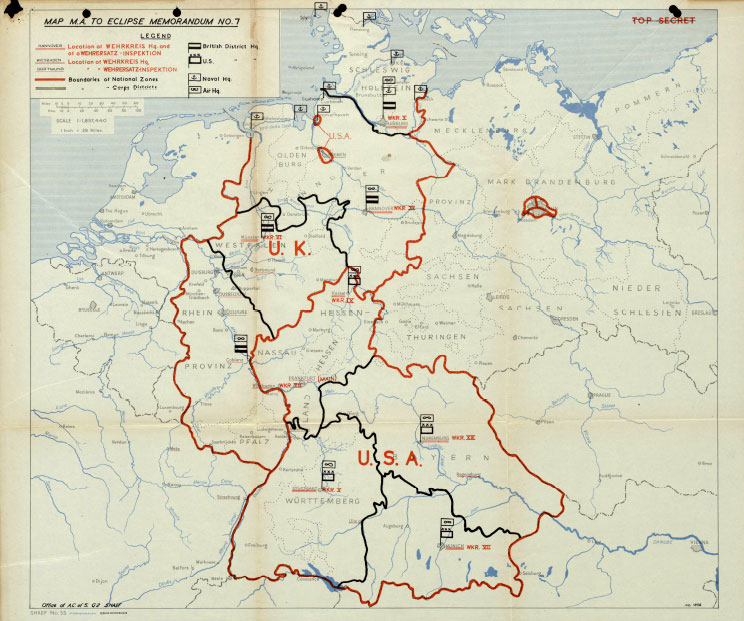
Operation Eclipse was a dossier about the plans for the German territory after the war. He included the new boundaries of Germany and the division of German territory among the Allies, as was appointed in the Yalta Meeting.
A copy of the plan from a British Headquarters fallen in German hands, and was classified as State Top Secret by Hitler. "His military advisers and their staffs could study the plan, but no on else. Not even the members of his own cabinet were informed".
The possibility of see the plan, despite being not a "strategic document - that is, it did not warn of imminent enemy moves that called for corresponding German countermoves", the plan helped to answer several questions that were in the mind of OKW for years. The first one: How srong was the alliance between the Western Powers and the Soviet Union?
It was known by the Germans the differences about Great Britain and Russia, the alliance between them was imposed by the need, before all. So, the big bet for the Germans was wait for the corrosion of the Alliance between the Allies given the different ideologies. This was the basic idea of the Ardennes offensive.
But the copy of Eclipse revealed that the plans were already made, the document was dated November 1944, defined as "planning and operations for the occupation of Germany".
"The Allied intent promised no hope, no future for Germany. It was clear that even if the Reich wished to capitulate, there was no way she could do so short of unconditional surrender. To Jodl, this meant that there was nothing left for Germany, but to fight to the end."
Heinrici, now formal commander of Army Group Vistula, after read carefully the plan, said: "Das ist ein Todesurteil - This is a death sentence".
Source: C. R. The last battle. 1966.
A reproduction of the Operation Eclipse can be found here.
domingo, 8 de maio de 2011
Army Group Vistula: Himmler
In January 1945, Guderian see the need of a formation of an Army Group "as the Polish front began to collapse before the tidal wave of Red Army".
 The new Army Group Vistula were intended, in Guderian's mind, to be commanded by Field Marshal Freiherr von Weichs. "At the time he was just the man for this job", Guderian said.
But the Führer considered von Weichs to old, and Jodl maded some "remarks about his religious feelings".
At that time, Himmler was Minister of Interior, Chief of Gestapo, head of the SS and commander of the Training Army.
After an agreement with Himmler, Guderian suggested to the Führer to relieve the "overburdened" Reichführer from Army Group Vistula, and after strong reluctance, Hitler agreed.

But the Führer considered von Weichs to old, and Jodl maded some "remarks about his religious feelings".
"Then", thundered Guderian, "whom did we get? Hitler appointed Himmler! Of all people - Himmler!"Under Himmler, without any experience commanding troops at the field, the front began to collapse.
At that time, Himmler was Minister of Interior, Chief of Gestapo, head of the SS and commander of the Training Army.
After an agreement with Himmler, Guderian suggested to the Führer to relieve the "overburdened" Reichführer from Army Group Vistula, and after strong reluctance, Hitler agreed.
Main source: C. R. The last battle. 1966.
Hitler's Antartic Base
Summerleaves and Beeching article: Hitler's Antartic base: the myth and the reality.
Full article, from Polar Record 43 (2007): www.histarmar.com.ar/antartida/base-hitler/labaseantarticadehitler.pdf
Full article, from Polar Record 43 (2007): www.histarmar.com.ar/antartida/base-hitler/labaseantarticadehitler.pdf
ABSTRACT. In January-February 1939, a secret German expedition visited Dronning (or Queen) Maud Land, Antarctica, apparently with the intention inter alia of establishing a base there. Between 1943 and 1945 the British launched a secret wartime Antarctic operation, code-named Tabarin. Men from the Special Air Services Regiment (SAS), Britain’s covert forces for operating behind the lines, appeared to be involved. In July and August 1945, after the German surrender, two U-boats arrived in Argentina. Had they been to Antarctica to land Nazi treasure or officials? In the southern summer of 1946–1947, the US Navy appeared to ‘invade’ Antarctica using a large force. The operation, code-named Highjump, was classified confidential. In 1958, three nuclear weapons were exploded in the region, as part of another classified US operation, code-named Argus. Given the initial lack of information about these various activities, it is not, perhaps, surprising that some people would connect them to produce a pattern in which governments would be accused of suppressing information about ‘what really happened’, and would use these pieces of information to construct a myth of a large German base existing in Antarctica and of allied efforts to destroy it. Using background knowledge of Antarctica and information concerning these activities that has been published since the early 1940s, it is demonstrated: that the two U-Boats could not have reached Antarctica; that there was no secret wartime German base in Dronning Maud Land; that SAS troops did not attack the alleged German base; that the SAS men in the region at the time had civilian jobs; that Operation Highjump was designed to train the US Navy for a possible war with the Soviet Union in the Arctic, and not to attack an alleged German base in Antarctica; and that Operation Argus took place over the ocean more than 2000 km north of Dronning Maud Land. Activities that were classified have subsequently been declassified and it is no longer difficult to separate fact from fancy, despite the fact that many find it attractive not to do so.
Colonel General Gotthard Heinrici
In December, 1941, Hitler's massive blitzkrieg offensive into Russia had finally ground to a frozen halt before the very approaches to Moscow. All along the German front more than 1,250,-000 lightly clad troops had been trapped by an early and bitter winter. As the Germans floundered through ice and snow, the Russian armies that Hitler and his experts had virtually written off appeared as if from nowhere. In an all-out attack, the Soviets threw one hundred divisions of winter-hardened soldiers against the invaders. The Germans armies were throw back with staggering losses, and for a time it seemed as if the terrible retreat of Napoleon's armies in 1812 would be repeated - on an even greater and bloodier scale.

The line had to be stabilized. It was Heinrici who was given the toughest sector to hold. On January 26, 1942, he was placed in command of the remnants of the Fourth Army, which holding the ground directly facing Moscow, was the kingpin of the German line. Any major withdrawal in its part would jeopardize the armies on either flank and might trigger a rout.
Heinrici took over on a bitterly cold day; the temperature stood at minus 42 degrees Fahrenheit. Water froze inside the boilers of locomotives, machine guns would not fire; trenches and foxholes could not be dug because the ground was like iron. Heinrici's ill-equipped soldiers were fighting in waist-deep snow, with icicles hanging from their nostrils and eyelashes. "I was told to hold out until the big attack that this time would sure take Moscow," he later recalled. "Yet all around me my men were dying - and not only from Russians bullets. Many of them froze to death."
[...]
Outside Moscow Heinrice developed a technique for which he became famous. When he knew a Russian a attack was imminent in a particular sector, he would order his troops to retreat the night before to new position one or two miles back. The Russians artillery barrages would land on a deserted front line. As Heinrici put it: "It was like hitting an empty bag. The Russians attack would lose its speed because my men, unharmed, would be ready. The my troops on sectors that had not been attacked would close in and reoccupy the original front lines." The trick was to know when the Russians were preparing for an attack. [...]
It was not always possible to emply these methods, and when he did, Heinrici had to use great caution - Hitler had imprisoned and even shot generals for defying his no-withdrawal order. "While we could hardly move a sentry from the window to the door without his permission," Heinrici was later record, "some of us, where we could, found ways to evade his more suicidal orders."
C. R. The last battle. 1966.Pages 73-74
quinta-feira, 5 de maio de 2011
segunda-feira, 2 de maio de 2011
A-Day: Foreword
Here is the foreword of The last battle, by Cornelius Ryan.
FOREWORD
A-Day, Monday, April 16, 1945
The battle for Berlin, the last offensive against Hitler's Third Reich, began at precisely 4 A.M., Monday, April 16, 1945 - or A-Day as it was called by the Western Allies. At that moment, less than thirty-eight miles east of the capital, red flares burst in the night skies above the swollen river Oder, triggering a stupefying artillery barrage and the opening of the Russian assault of the city.
At about that same time, elements of the U.S. Ninth Army were turning away from Berlin - heading back to the west to take new positions along the river Elbe between Tangermünde and Barby. On April 14 General Eisenhower had decided to halt the Anglo-American drive across Germany. "Berlin", he said, "is no longer a military objective." When U.S. troops got the word, Berlin, for some of them, was only forty-five miles away.
As the attack began, Berliners waited in the bombed rubble of their city, numb and terrified, clinging to the only politics that now counted - the politics of survival. To eat had become more important than to love, to burrow more dignified than to fight, to endure more military correct than to win.
What follows is the story of the last battle - the assault and capture of Berlin. Although this book accounts of the fighting, it is not a military report. Rather, it is the story of ordinary people, both soldiers and civilians, who were caught up in despair, frustration, terror and rape of the defeat and the victory.
C. R. The last battle. Page 9.
Peter Fechter
Starting now to read The last battle by Cornelius Ryan, finishing then his trilogy. In the very beginning, good quotes:
This book is for the memory of a boy who has born in Berlin during the last months of the war, his name was Peter Fechter. In 1962 he was machine-gunned by his own people and left to bleed to death by the side of the most tragic memorial to the allied victory - the Berlin wall.
A book telling the fall of Berlin by the Soviet Union, written by an American, in 1966.
Of the events of war, I have not ventured to speak from any chance information, nor according to any notation of my own; I have described nothing but what I saw myself, or learned from others of whom I made the most careful and particular inquiry. The task was a laborious one because eyewitnesses of the same occurrence gave different accounts of them as they remembered, or were interested in the actions of one side or the other. And very likely the strictly historical character of my narrative may be disappointing to the ear. But if the who desires to have before his eyes a true picture of the events which have happened ... shall pronounce what I have written to be useful, the I shall be satisfied.
- Thucydes, Peloponesian War
Volume 1, 400 B.C. [Quoted by Ryan]
A difficult topic in a difficult time: probably a good book.
sexta-feira, 22 de abril de 2011
Seven days in may
On this holiday, I begin to read the book "Seven Days in May", by Flecther Knebel and Charles W. Bailey II, from 1962. It's looking like a very good cold war book.
After finish the book, I pretend to see the movie, with Burt Lancaster, Kirk Douglas, Ava Gardner and other stars.
After finish the book, I pretend to see the movie, with Burt Lancaster, Kirk Douglas, Ava Gardner and other stars.
terça-feira, 19 de abril de 2011
Ribbentrop Hotel
On 28 September 1941, the British mission arrived Moscow. "Their reception was bleak and discussions not at all friendly" Churchill says.
One incident preserved by General Ismay in an apocryphal and somewhat lively form may be allowed to lighten the narrative. His orderly, a Royal Marine, was shown the sights of Moscow by one of the Intourist guides. "This," said the Russian, "is the Eden Hotel, formely Ribbentrop Hotel. Here is Churchill Street, formely Hitler Street. Here is the Beaverbrook railway station, formely Goering railway station Will you have a cigarette, comrade?" The marine replied, "Thank you, comrade, formely bastard!" This tale, though jocular, illustrates none the less the strange atmosphere of the meetings.
W. S. C. The grand alliance. Page 416

segunda-feira, 18 de abril de 2011
Friend or foe?
After the Atlantic Charter, Churchill talks with the Soviet Ambassador. The mood was the letters exchanged by Churchill and Stalin about a second front on West, and outstanding requests made by Stalin on that moment.
The Soviet Ambassador, who was accompanied by Mr. Eden, stayed and talked with me for an hour and a half. He emphasised (sic) in bitter terms how for the last eleven weeks Russia had been bearing the brunt of the German onslaught virtually alone. The Russian armies were now enduring a weight of attach never equaled before. He said that he did not wish to use dramatic language, but this might be a turning-point in history. If Soviet Russia were defeated how could we win the war? M. Maisky emphasized the extreme gravity of the crisis on the Russian front in poignant terms which commanded my sympathy. But when presently I sensed an underlying air of menace in his appeal I was angered. I said to the Ambassador, whom I had know for many years, "Remember that only four months ago we in this Island did not know whether you were not coming in against us on the German side. Indeed, we thought it quite likely that you would. Even then we felt sure we should win in the end. We never thought our survival was dependent on your action either way. Whatever happens, and whatever you do, you of all people have no right to make reproaches on us". As I warmed to the topic the Ambassador exclaimed, "More calm, please, my dear Mr. Churchill", but thereafter his tone perceptibly changed.
W. S. C. The grand alliance. pages 406-407.

Iceland (C)
On a letter to Lord Privy Seal, transcribed on The Grand Alliance, pages 397-398, Churchill makes a comment about Iceland, and remarks a careful procedure to cite this country.
The text:
[...] Franklin Junior is serving on one of them, and has been appointed Liaison Officer to me during my day in Iceland (C)*, where there will be a joint review of British and American Forces.The note:
* To avoid confusion with Ireland, I had directed that Iceland was always to be written by the British authorities as Iceland (C). This was a necessary precaution.
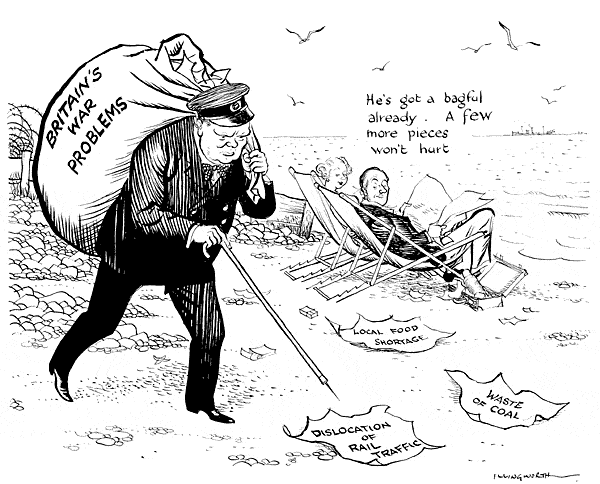
Atlantic Charter (2)
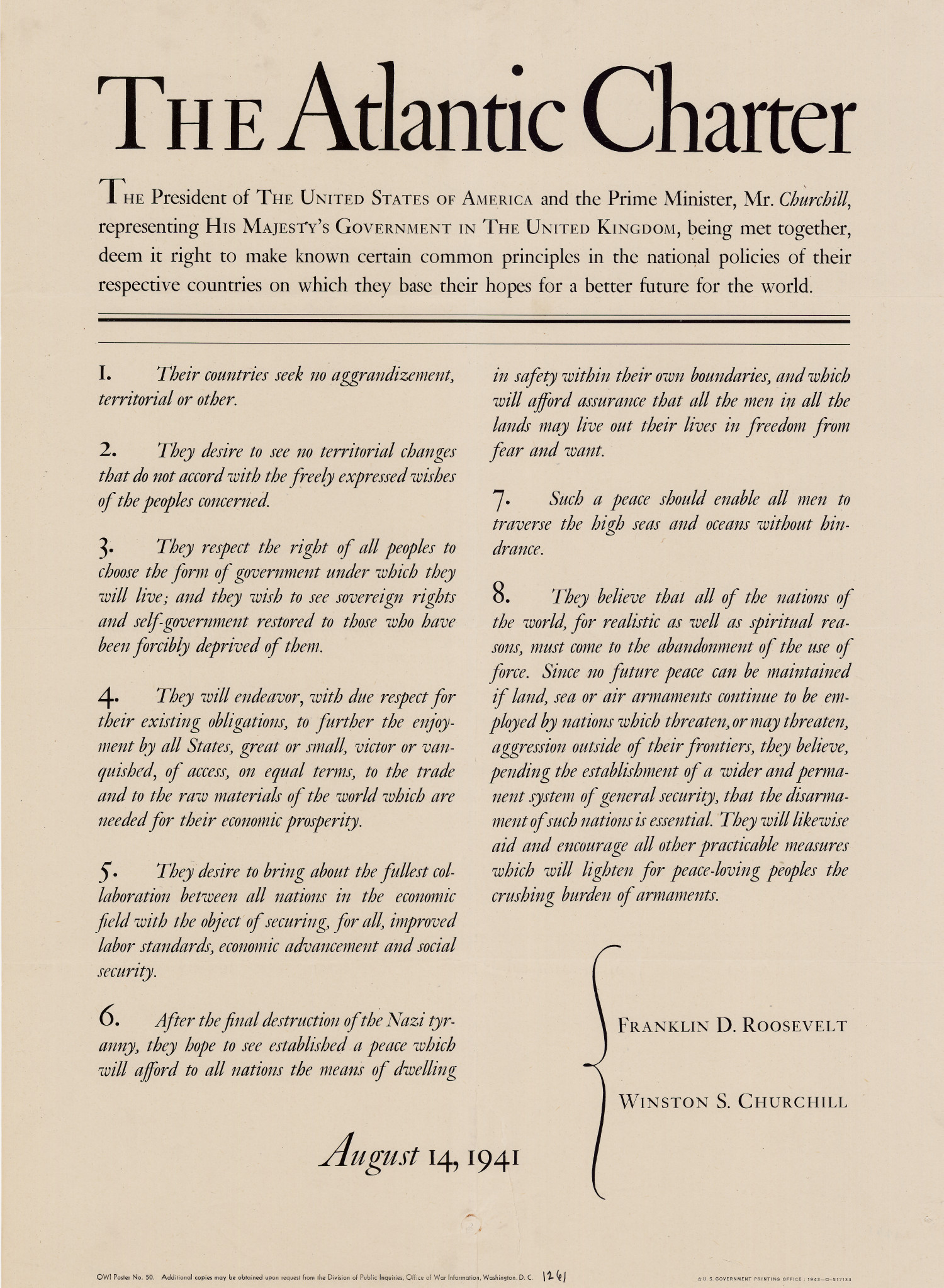
The profound and far-reaching importance of this Joint Declaration was apparent. The fact alone of the United States, still technically neutral, joining with a belligerent Power in making such a declaration was astonishing. The inclusion in it of a reference to "the final destruction of the Nazi tyranny" (this was based on a phrase appearing in my original draft, amounted to a challenge which in ordinary times would have implied war-like action. Finally, not the least striking feature was the realism of the last paragraph, where there was a plain and bold intimation that after the war the United States would join with us in policing the world until the establishment of a better order.
W. S. C. The grand alliance. Page 394.
domingo, 17 de abril de 2011
Atlantic Charter
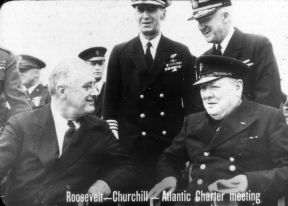
On chapters XXIIV and XXIV of "The Grand Alliance", the Atlantic Charter is presented.
This meeting was of great importance for a narrower definition of relations between the United States of America and the British Empire, defining key points in the relation of these two great powers in a direct and personal way. So far, the relationship between Winston Churchill and Roosevelt were made only by letters, where Churchill identified himself as "Former Naval Person".
The meeting venue has been set: Placentia Bay, Newfoundland. The battleship Prince of Wales was designated to lead the British delegation.
The meeting was held at sea in extreme secrecy. The President Rooselvet was formally resting on a cruise. On sea, he transfer to the cruiser Augusta, leaving his yacht.
 |
| USS McDougal (DD-358) alongside HMS Prince of Wales |
On the second day, the Prince of Wales encountered heavy seas, remaining two options: slow down or dropping the destroyer escort. Admiral Pound gave the decision, entering in a high speed zone.
Without the escort, in a sea infested by U-Boats, the battleship had to perform several diversions, keeping a radio silence status.
This gave Mr. Churchill a lot of free time, something completely different in his routine.
For the first time for many months I could read a book for pleasure. Oliver Lyttelton, Minister of State in Cairo, had given me Captain Hornblower, R. N., [C. S. Forester], which I found vastly entertaining. When a chance came I sent him the message: "I find Hornblower admirable". This caused pertubation in the Middle East Headquarters, where it was imagined that "Hornblower" was the code-word for some special operations of which they had not been told.
W. S. C. The Grand Alliance. Page 382

quarta-feira, 13 de abril de 2011
Tobruk: Australia
In the verge of operation "Crusader" and the defense of Tobruk, the Australian government called back his troops. After Mr. Fadden become first minister of Australia Dominion, preceded by Mr. Menzies, Churchill writes:
The new Government under hard pressure from its opponents, was much concerned about the position of the Australian division on Tobruk. They desired to collect their troops in the Middle East into one force in order to give them an opportunity for refreshment, restoration of discipline and re-equipment, and to satisfy public opinion in Australia. [...] They therefore demanded their immediate relief by other forces.
The Grand Alliance, page 367
It is know that the public opinion was saying that the British were deploying only Dominion's forces, saving their owns.
Several asks were made for changes on that demand, or, at least, a postponing till Crusader being launch. Always negative anwers. So, the relief of the Australian troops had begin.
On the night of October 25 [1941] the operations so greatly desired by both Australian parties was attempted under conditions of great danger, and not without appreciable loss [...]
The Grand Alliance, page 367
The fast minelayer H. M. S. Latonia was sunk and the destroyer Hero was damaged by air attack, and tens of Australians were missing or wounded.
We must be thankful these air attacks did not start in the earlier stages of the relief.
The Grand Alliance, page 367
quarta-feira, 6 de abril de 2011
Kemper Lecture - March 6, 2011
Quoting The Churchill Centre, and messagem from John David Olsen in ChurchillChat group.
Sir Max Hastings delivers the annual Kemper Lecture as part of the 2011 Churchill Weekend on the campus of Westminster College.
Sir Max is the author of 21 books, eight of them about the Second World War. His address is titled "Winston Churchill: The Indispensable Man."
Sir Max Hastings delivers the annual Kemper Lecture as part of the 2011 Churchill Weekend on the campus of Westminster College.
Sir Max is the author of 21 books, eight of them about the Second World War. His address is titled "Winston Churchill: The Indispensable Man."
Assinar:
Postagens (Atom)