First Speech as Prime Minister to House of Commons
On May 10, 1940, Winston Churchill became Prime Minister. When he met his Cabinet on May 13 he told them that "I have nothing to offer but blood, toil, tears and sweat." He repeated that phrase later in the day when he asked the House of Commons for a vote of confidence in his new all-party government. The response of Labour was heart-warming; the Conservative reaction was luke-warm. They still really wanted Neville Chamberlain. For the first time, the people had hope but Churchill commented to General Ismay: "Poor people, poor people. They trust me, and I can give them nothing but disaster for quite a long time."
The text:
On Friday evening last I received His Majesty's commission to form a new Administration. It as the evident wish and will of Parliament and the nation that this should be conceived on the broadest possible basis and that it should include all parties, both those who supported the late Government and also the parties of the Opposition. I have completed the most important part of this task. A War Cabinet has been formed of five Members, representing, with the Opposition Liberals, the unity of the nation. The three party Leaders have agreed to serve, either in the War Cabinet or in high executive office. The three Fighting Services have been filled. It was necessary that this should be done in one single day, on account of the extreme urgency and rigour of events. A number of other positions, key positions, were filled yesterday, and I am submitting a further list to His Majesty to-night. I hope to complete the appointment of the principal Ministers during to-morrow. the appointment of the other Ministers usually takes a little longer, but I trust that, when Parliament meets again, this part of my task will be completed, and that the administration will be complete in all respects.
I considered it in the public interest to suggest that the House should be summoned to meet today. Mr. Speaker agreed, and took the necessary steps, in accordance with the powers conferred upon him by the Resolution of the House. At the end of the proceedings today, the Adjournment of the House will be proposed until Tuesday, 21st May, with, of course, provision for earlier meeting, if need be. The business to be considered during that week will be notified to Members at the earliest opportunity. I now invite the House, by the Motion which stands in my name, to record its approval of the steps taken and to declare its confidence in the new Government.
To form an Administration of this scale and complexity is a serious undertaking in itself, but it must be remembered that we are in the preliminary stage of one of the greatest battles in history, that we are in action at many other points in Norway and in Holland, that we have to be prepared in the Mediterranean, that the air battle is continuous and that many preparations, such as have been indicated by my hon. Friend below the Gangway, have to be made here at home. In this crisis I hope I may be pardoned if I do not address the House at any length today. I hope that any of my friends and colleagues, or former colleagues, who are affected by the political reconstruction, will make allowance, all allowance, for any lack of ceremony with which it has been necessary to act. I would say to the House, as I said to those who have joined this government: "I have nothing to offer but blood, toil, tears and sweat."
We have before us an ordeal of the most grievous kind. We have before us many, many long months of struggle and of suffering. You ask, what is our policy? I can say: It is to wage war, by sea, land and air, with all our might and with all the strength that God can give us; to wage war against a monstrous tyranny, never surpassed in the dark, lamentable catalogue of human crime. That is our policy. You ask, what is our aim? I can answer in one word: It is victory, victory at all costs, victory in spite of all terror, victory, however long and hard the road may be; for without victory, there is no survival. Let that be realized; no survival for the British Empire, no survival for all that the British Empire has stood for, no survival for the urge and impulse of the ages, that mankind will move forward towards its goal. But I take up my task with buoyancy and hope. I feel sure that our cause will not be suffered to fail among men. At this time I feel entitled to claim the aid of all, and I say, "come then, let us go forward together with our united strength."
Yesterday I saw a great movie, called "The sinking of Laconia". It's a British production, in two parts, showing the incident with RMS Laconia and consequences.
The audio seems to be incompletely. Below I present the whole speech, where the audio part is presented in bold.
I avail myself with relief of the opportunity of speaking to the people of the United States. I do not know how long such liberties will be allowed. The stations of uncensored expression are closing down; the lights are going out; but there is still time for those to whom freedom and parliamentary government mean something, to consult together. Let me, then, speak in truth and earnestness while time remains.
The American people have, it seems to me, formed a true judgment upon the disaster which has befallen Europe. They realise, perhaps more clearly than the French and British publics have yet done, the far-reaching consequences of the abandonment and ruin of the Czechoslovak Republic. I hold to the conviction I expressed some months ago, that if in April, May or June, Great Britain, France, and Russia had jointly declared that they would act together upon Nazi Germany if Herr Hitler committed an act of unprovoked aggression against this small State, and if they had told Poland, Yugoslavia, and Rumania what they meant to do in good time, and invited them to join the combination of peace-defending Powers, I hold that the German Dictator would have been confronted with such a formidable array that he would have been deterred from his purpose. This would also have been an opportunity for all the peace-loving and moderate forces in Germany, together with the chiefs of the German Army, to make a great effort to re-establish something like sane and civilised conditions in their own country. If the risks of war which were run by France and Britain at the last moment had been boldly faced in good time, and plain declarations made, and meant, how different would our prospects be today!
But all these backward speculations belong to history. It is no good using hard words among friends about the past, and reproaching one another for what cannot be recalled. It is the future, not the past, that demands our earnest and anxious thought. We must recognize that the Parliamentary democracies and liberal, peaceful forces have everywhere sustained a defeat which leaves them weaker, morally and physically, to cope with dangers which have vastly grown. But the cause of freedom has in it a recuperative power and virtue which can draw from misfortune new hope and new strength. If ever there was a time when men and women who cherish the ideals of the founders of the British and American Constitutions should take earnest counsel with one another, that time is now.
All the world wishes for peace and security. Have we gained it by the sacrifice of the Czechoslovak Republic. Here was the model democratic State of Central Europe, a country where minorities were treated better than anywhere else. It has been deserted, destroyed and devoured. It is now being digested. The question which is of interest to a lot of ordinary people, common people, is whether this destruction of the Czechoslovak Republic will bring upon the world a blessing or a curse.
We must all hope it will bring a blessing; that after we have averted our gaze for a while from the process of subjugation and liquidation, everyone will breathe more freely; that a load will be taken off our chests; we shall be able to say to ourselves: "Well, that's out of the way, anyhow. Now let's get on with our regular daily life." But are these hopes well founded or are we merely making the best of what we had not the force and virtue to stop? That is the question that the English-speaking peoples in all their lands must ask themselves today. Is this the end, or is there more to come?
There is another question which arises out of this. Can peace, goodwill, and confidence be built upon submission to wrong-doing backed by force?
One may put this question in the largest form. Has any benefit or progress ever been achieved by the human race by submission to organised and calculated violence? As we look back over the long story of the nations we must see that, on the contrary, their glory has been founded upon the spirit of resistance to tyranny and injustice, especially when these evils seemed to be backed by heavier force. Since the dawn of the Christian era a certain way of life has slowly been shaping itself among the Western peoples, and certain standards of conduct and government have come to be esteemed. After many miseries and prolonged confusion, there arose into the broad light of day the conception of the right of the individual; his right to be consulted in the government of his country; his right to invoke the law even against the State itself. Independent Courts of Justice were created to affirm and inforce this hard-won custom. Thus was assured throughout the English-speaking world, and in France by the stern lessons of the Revolution, what Kipling called, "Leave to live by no man's leave underneath the law." Now in this resides all that makes existence precious to man, and all that confers honour and health upon the State.
We are confronted with another theme. It is not a new theme; it leaps out upon us from the Dark Ages - racial persecution, religious intolerance, deprivation of free speech, the conception of the citizen as a mere soulless fraction of the State. To this has been added the cult of war. Children are to be taught in their earliest schooling the delights and profits of conquest and aggression. A whole mighty community has been drawn painfully, by severe privations, into a warlike frame. They are held in this condition, which they relish no more than we do, by a party organisation, several millions strong, who derive all kinds of profits, good and bad, from the upkeep of the regime. Like the Communists, the Nazis tolerate no opinion but their own. Like the Communists, they feed on hatred. Like the Communists, they must seek, from time to time, and always at shorter intervals, a new target, a new prize, a new victim. The Dictator, in all his pride, is held in the grip of his Party machine. He can go forward; he cannot go back. He must blood his hounds and show them sport, or else, like Actaeon of old, be devoured by them. All-strong without, he is all-weak within. As Byron wrote a hundred years ago: "These Pagod things of Sabre sway, with fronts of brass and feet of clay."
No one must, however, underrate the power and efficiency of a totalitarian state. Where the whole population of a great country, amiable, good-hearted, peace-loving people are gripped by the neck and by the hair by a Communist or a Nazi tyranny - for they are the same things spelt in different ways - the rulers for the time being can exercise a power for the purposes of war and external domination before which the ordinary free parliamentary societies are at a grievous practical disadvantage. We have to recognise this. And then, on top of all, comes this wonderful mastery of the air which our century has discovered, but of which, alas, mankind has so far shown itself unworthy. Here is this air power with its claim to torture and terrorise the women and children, the civil population of neighbouring countries.
This combination of medieval passion, a party caucus, the weapons of modern science, and the blackmailing power of air-bombing, is the most monstrous menace to peace, order and fertile progress that has appeared in the world since the Mongol invasions of the thirteenth century.
The culminating question to which I have been leading is whether the world as we have known it - the great and hopeful world of before the war, the world of increasing hope and enjoyment for the common man, the world of honoured tradition and expanding science - should meet this menace by submission or by resistance. Let us see, then, whether the means of resistance remain to us today. We have sustained an immense disaster; the renown of France is dimmed. In spite of her brave, efficient army, her influence is profoundly diminished. No one has a right to say that Britain, for all her blundering, has broken her word - indeed, when it was too late, she was better than her word. Nevertheless, Europe lies at this moment abashed and distracted before the triumphant assertions of dictatorial power. In the Spanish Peninsula, a purely Spanish quarrel has been carried by the intervention, or shall I say the "non-intervention" (to quote the current Jargon) of Dictators into the region of a world cause.
But it is not only in Europe that these oppressions prevail. China is being torn to pieces by a military clique in Japan; the poor, tormented Chinese people there are making a brave and stubborn defence. The ancient empire of Ethiopia has been overrun. The Ethiopians were taught to look to the sanctity of public law, to the tribunal of many nations gathered in majestic union. But all failed; they were deceived, and now they are winning back their right to live by beginning again from the bottom a struggle on primordial lines. Even in South America, the Nazi regime begins to undermine the fabric of Brazilian society.
Far away, happily protected by the Atlantic and Pacific Oceans, you, the people of the United States, to whom I now have the chance to speak, are the spectators, and I may add the increasingly involved spectators of these tragedies and crimes. We are left in no doubt where American conviction and sympathies lie; but will you wait until British freedom and independence have succumbed, and then take up the cause when it is three-quarters ruined, yourselves alone? I hear that they are saying in the United States that because England and France have failed to do their duty therefore the American people can wash their hands of the whole business. This may be the passing mood of many people, but there is no sense in it. If things have got much worse, all the more must we try to cope with them.
For, after all, survey the remaining forces of civilisation; they are overwhelming. If only they were united in a common conception of right and duty, there would be no war. On the contrary, the German people, industrious, faithful, valiant, but alas! lacking in the proper spirit of civic independence, liberated from their present nightmare, would take their honoured place in the vanguard of human society. Alexander the Great remarked that the people of Asia were slaves because they had not learned to pronounce the word "No." Let that not be the epitaph of the English-speaking peoples or of Parliamentary democracy, or of France, or of the many surviving liberal States of Europe.
There, in one single word, is the resolve which the forces of freedom and progress, of tolerance and good will, should take. It is not in the power of one nation, however formidably armed, still less is it in the power of a small group of men, violent, ruthless men, who have always to cast their eyes back over their shoulders, to cramp and fetter the forward march of human destiny. The preponderant world forces are upon our side; they have but to be combined to be obeyed. We must arm. Britain must arm. America must arm. If, through an earnest desire for peace, we have placed ourselves at a disadvantage, we must make up for it by redoubled exertions, and, if necessary, by fortitude in suffering.
We shall, no doubt, arm. Britain, casting away the habits of centuries, will decree national service upon her citizens. The British people will stand erect, and will face whatever may be coming.
But arms - instrumentalities, as President Wilson called them - are not sufficient by themselves. We must add to them the power of ideas. People say we ought not to allow ourselves to be drawn into a theoretical antagonism between Nazidom and democracy; but the antagonism is here now. It is this very conflict of spiritual and moral ideas which gives the free countries a great part of their strength. You see these dictators on their pedestals, surrounded by the bayonets of their soldiers and the truncheons of their police. On all sides they are guarded by masses of armed men, cannons, aeroplanes, fortifications, and the like - they boast and vaunt themselves before the world, yet in their hearts there is unspoken fear. They are afraid of words and thoughts; words spoken abroad, thoughts stirring at home - all the more powerful because forbidden - terrify them. A little mouse of thought appears in the room, and even the mightiest potentates are thrown into panic. They make frantic efforts to bar our thoughts and words; they are afraid of the workings of the human mind. Cannons, airplanes, they can manufacture in large quantities; but how are they to quell the natural promptings of human nature, which after all these centuries of trial and progress has inherited a whole armoury of potent and indestructible knowledge?
Dictatorship - the fetish worship of one man - is a passing phase. A state of society where men may not speak their minds, where children denounce their parents to the police, where a business man or small shopkeeper ruins his competitor by telling tales about his private opinions; such a state of society cannot long endure if brought into contact with the healthy outside world.
The light of civilised progress with its tolerances and co-operation, with its dignities and joys, has often in the past been blotted out. But I hold the belief that we have now at last got far enough ahead of barbarism to control it, and to avert it, if only we realise what is afoot and make up our minds in time. We shall do it in the end. But how much harder our toil for every day's delay!
Is this a call to war? Does anyone pretend that preparation for resistance to aggression is unleashing war? I declare it to be the sole guarantee of peace. We need the swift gathering of forces to confront not only military but moral aggression; the resolute and sober acceptance of their duty by the English-speaking peoples and by all the nations, great and small, who wish to walk with them. Their faithful and zealous comradeship would almost between night and morning clear the path of progress and banish from all our lives the fear which already darkens the sunlight to hundreds of millions of men.
The audio seems to be incompletely. Below I present the whole speech, where the audio part is presented in bold.
I have but a short time to deal with this enormous subject and I beg you therefore to weigh my words with the attention and thought which I have given to them.
As we go to and fro in this peaceful country with its decent, orderly people going about their business under free institutions and with so much tolerance and fair play in their laws and customs, it is startling and fearful to realize that we are no longer safe in our island home.
For nearly a thousand years England has not seen the campfires of an invader. The stormy sea and our royal navy have been our sure defense. Not only have we preserved our life and freedom through the centuries, but gradually we have come to be the heart and center of an empire which surrounds the globe.
It is indeed with a pang of stabbing pain that we see all this in mortal danger. A thousand years has served to form a state; an hour may lay it in dust.
What shall we do? Many people think that the best way to escape war is to dwell upon its horrors and to imprint them vividly upon the minds of the younger generation. They flaunt the grisly photograph before their eyes. They fill their ears with tales of carnage. They dilate upon the ineptitude of generals and admirals. They denounce the crime as insensate folly of human strife. Now, all this teaching ought to be very useful in preventing us from attacking or invading any other country, if anyone outside a madhouse wished to do so, but how would it help us if we were attacked or invaded ourselves that is the question we have to ask.
Would the invaders consent to hear Lord Beaverbrook's exposition, or listen to the impassioned appeals of Mr. Lloyd George? Would they agree to meet that famous South African, General Smuts, and have their inferiority complex removed in friendly, reasonable debate? I doubt it. I have borne responsibility for the safety of this country in grievous times. I gravely doubt it.
But even if they did, I am not so sure we should convince them, and persuade them to go back quietly home. They might say, it seems to me, "you are rich; we are poor. You seem well fed; we are hungry. You have been victorious; we have been defeated. You have valuable colonies; we have none. You have your navy; where is ours? You have had the past; let us have the future." Above all, I fear they would say, "you are weak and we are strong."
After all, my friends, only a few hours away by air there dwell a nation of nearly seventy millions of the most educated, industrious, scientific, disciplined people in the world, who are being taught from childhood to think of war as a glorious exercise and death in battle as the noblest fate for man.
There is a nation which has abandoned all its liberties in order to augment its collective strength. There is a nation which, with all its strength and virtue, is in the grip of a group of ruthless men, preaching a gospel of intolerance and racial pride, unrestrained by law, by parliament, or by public opinion. In that country all pacifist speeches, all morbid war books are forbidden or suppressed, and their authors rigorously imprisoned. From their new table of commandments they have omitted "thou shall not kill."
It is but twenty years since these neighbors of ours fought almost the whole world, and almost defeated them. Now they are rearming with the utmost speed, and ready to their hands is the new lamentable weapon of the air, against which our navy is -no defense, and before which women and children, the weak and frail, the pacifist and the jingo, the warrior and the civilian, the front line trenches and the cottage home, all lie in equal and impartial peril.
Nay, worse still, for with the new weapon has come a new method, or rather has come back the most British method of ancient barbarism, namely, the possibility of compelling the submission of nations by terrorizing their civil population; and, worst of all, the more civilized the country is, the larger and more splendid its cities, the more intricate the structure of its civil and economic life, the more is it vulnerable and at the mercy of those who may make it their prey.
Now, these are facts, hard, grim, indisputable facts, and in the face of these facts, I ask again, what are we to do?
There are those who say, "Let us ignore the continent of Europe. Let us leave it with its hatreds and its armaments, to stew in its own juice, to fight out its own quarrels, and decree its own doom. Let us turn our backs to this melancholy and alarmist view. Let us fix our gaze across the ocean and see our own life in our own dominions and empires."
There would be very much to this plan if only we could unfasten the British islands from their rock foundations, and could tow them three thousand miles across the Atlantic Ocean, and anchor them safely upon the smiling coasts of Canada; but I have not yet heard of any way in which this could be done.
At present we lie within a few minutes' striking distance of the French, Dutch, and Belgian coasts, and within a few hours of the great aerodromes of Central Europe. We are even within cannon shot of the continent-so close as that. Is it prudent, is it possible, however we might desire it, to turn our backs upon Europe and ignore whatever may happen there? Everyone can judge this question for himself, and everyone ought to make up his mind or her mind, let me say, about it without delay. It lies at the heart of our problems.
For my part, I have come to the conclusion, reluctantly I admit, that we cannot get away. Here we are and we must make the best of it, but do not, I beg you, underrate the risks, the grievous risks we have to run. I hope, I pray, and, on the whole, grasping the larger hope, I believe, that no war will fall upon us; but if in the near future the great war of 1914 is resumed again in Europe, no one can tell where and how it would end or whether sooner or later we should not be dragged into it, dragged into it as the United States was dragged in against their will in 1917. Whatever happens, and whatever we did, it would be a time of frightful danger for us, and, when the war was over, or perhaps while it still raged, we should be brought face to face with the victors, whoever they might be. Indeed, with our wealth and vast possessions, we should be the only prize sufficient to reward their exert-ion and compensate them for their losses.
Then certainly those who had tried to forget Europe would have to turn round very quickly indeed and then it would-be too late. Therefore, it seems to me that we cannot detach ourselves from Europe and that for our own safety and self-preservation we are bound to make exertions and run risks for the sake of keeping peace.
There are some who say, indeed it has been the shrill cry of the hour, that we should run the risk of disarming ourselves in order to set an example to others. We have done that already. We have done it for the last five years, but our example has not been followed. On the contrary, it has produced, as I ventured to predict, the opposite results. All the other countries have armed only the more heavily, and the quarrels and intrigues about disarmament have only bred more ill will between the nations.
Everyone would be glad to see the burden of armaments reduced in every country, but history shows on many a page that armaments are not necessarily a cause of war and that the want of them has been no guarantee of peace. If, for instance, all the explosives all over the world could, by a wave of a magic wand be robbed of their power and made harmless, so that not a cannon nor a rifle could fire and not a shell or a bomb detonate, that would be a measure of world disarmament far beyond the brightest dreams of Geneva, but would it insure peace? That is the question. On the contrary, in my belief, war would begin almost the next day when enormous masses of fierce men armed with picks, spades, or with clubs and spears, would pour over the frontiers into the lands they covet.
This truth may be unfashionable, unpalatable, no doubt unpopular, but, if it is the truth, the story of mankind shows that war was universal and unceasing for millions of years before armaments were invented or armies organized. Indeed, the lucid intervals of peace and order only occurred in human history after armaments in the hands of strong governments have come into being, and civilization in every age has been nursed only in cradles guarded by superior weapons and superior discipline.
To remove the causes of war, we must go deeper than armaments. We must remove grievances and injustice. We must raise human thought to a higher plane. We must give a new inspiration to the world. Let moral disarmament come and physical disarmament will soon follow.
That is but one side of this. Is there another? . When we look out upon the state of Europe and of the world and of the position of our own country as they are tonight, it seems to me that the next year or two years may contain a faithful turning point in our history. I am afraid that if you look intently at what is moving towards Great Britain, you will see that the only choice open is the old grim choice our forebears had to face, namely, whether we shall submit or whether we shall prepare, whether we shall submit to the will of the stronger nation or whether we shall prepare to defend our rights, our liberties, and indeed, our lives.
If we submit, our submission should be timely. If we prepare, our preparation should not be too late. Submission will entail at the very least, the passing and distribution of the British empire, and the acceptance by our people within and under a Teutonic domination of Europe of whatever future may be in store for small countries like Norway, Sweden, Denmark, Holland, Belgium, and Switzerland.
The difficulty about submission-I state it calmly-the difficulty is that we have already in this island the population of a first class power, and on our new scale of life as a small state, we could not feed more than perhaps half of those who live here now. Great stresses will arise in deciding which half shall survive.
You have perhaps read the story of the wrath of Medusa. I will not dwell on that repulsive theme. These are the disadvantages of the submission and of Great Britain definitely releasing her position in the world.
Preparation involves statesmanship, expense, and exertion, and neither submission nor preparation are free from suffering and danger.
I should not speak to you, my friends, fellow countrymen, in this way, if I were not prepared to declare to you some of the measures of preparation by which I believe another great war may be averted and our destruction be prevented should war come. First, we must without another day's delay begin to make ourselves at least the strongest air power in the European world. By this means we shall recover to a very large extent the safety which we formerly enjoyed through our navy, and through our being an island. By this means we shall free ourselves from the dangers of being blackmailed against our will, either to surrender our possessions or even hand over such means of defense as we still possess, or of being forced to join in a continental war against our wish or against our feeling of right and justice.
By this means we shall remove from Europe that additional danger to peace which arises when ;a very wealthy nation and empire is so obviously undefended that it lies an inviting bait or prey to the ambition or appetite of hungry powers.
But that is not all we should do. I look to the League of Nations as being an instrument which, properly sustained and guided, may preserve the threatened peace of the world. I know it is fashionable in some quarters-in many quarters -to mock at the League of Nations, but where is there any other equal hope?
The many countries, great and small, that are afraid of being absorbed or invaded by Germany, should lay their fears and their facts before the League of Nations. If the League of Nations is satisfied that these fears are justified, it should call upon its members to volunteer as special constables for the preservation of peace against a particular danger. Naturally, those would be most ready to volunteer whose homes lay nearest the regions where the outbreak was most likely to occur. It might well be that not only two or three nations but eight or ten would be found willing in their own interests and in the interests of peace to undertake this special obligation. There would then come into being within the League of Nations and under the formal Authority, a special service band of nations who are in danger, and who want to be let alone. It would be a confederation not merely of the peace-loving powers for everyone will say they are that but of the peace-interested powers, a league of those who have most to lose by war and are nearest to the danger.
I accept the words which General Smuts used only on Monday last. "There should be," he said, "a smaller group within the league, -entering into mutual defensive arrangements under the aegis and subject to the control of the league."
Those are words of wisdom and it seems to me that Great Britain should not refuse to bear her share and do her part in this.
These volunteer special constables should not only be authorized, but urged by the League of Nations to concert with one another measures of mutual defense against the invasion of any one of them, whether by land, sea, or air; to undertake to maintain forces while the danger lasts.
You have heard the old doctrine of the balance of power. I don't accept it. Anything like a balance of power in Europe will lead to war. Great wars usually come only when both sides think they have good hopes of victory. Peace must -be founded upon preponderance. There is safety in numbers. If there were five or six on each side, there might well be, a frightful trial of strength, but if there were eight or ten on one side and only one or two upon the other, and if the collective armed forces of one side were three or four times as large as those of the other, then there would be no war.
The practical arrangements which are appropriate to one region of the world may be repeated elsewhere in different combinations for other dangers and in other fields, and it might well be that gradually the whole world would be laced with international insurances against individual aggressors, and confidence and safety would return to mankind.
If the first stage of such a structure could be built up by the League of Nations at the present time-and there may still be time-it would, I believe, enable us to get through the next ten years without a horrible and fatal catastrophe, and in that interval, in that blessed breathing space, we might be able to reconstruct the life of Europe and reunite in justice and good will our sundered and quaking civilization. May God protect us all.
I was asked last week whether I was aware of some uneasiness which it was said existed in the country on account of the gravity, as it was described, of the war situation. So I thought it would be a good thing to go and see for myself what this 'uneasiness' amounted to, and I went to some of our great cities and seaports which had been most heavily bombed, and to some of the places where the poorest people had got it worst. I have come back not only reassured, but refreshed. To leave the offices in Whitehall with their ceaseless hum of activity and stress, and go out to the front, by which I mean the streets and wharves of London or Liverpool, Manchester, Cardiff, Swansea or Bristol, is like going out of a hothouse on to the bridge of a fighting ship. It is a tonic which I should recommend any who are suffering from fretfulness to take in strong doses when they have need of it.
It is quite true that I have seen many painful scenes of havoc, and of fine buildings and acres of cottage homes blasted into rubble-heaps of ruin. But it is just in those very places where the malice of the savage enemy has done its worst, and where the ordeal of the men, women and children has been most severe, that I found their morale most high and splendid. Indeed, I felt encompassed by an exaltation of spirit in the people which seemed to lift mankind and its troubles above the level of material facts into that joyous serenity we think belongs to a better world than this.
Of their kindness to me I cannot speak, because I have never sought it or dreamed of it, and can never deserve it. I can only assure you that I and my colleagues, or comrades rather - for that is what they are - will toil with every scrap of life and strength, according to the lights that are granted to us, not to fail these people or be wholly unworthy of their faithful and generous regard. The British nation is stirred and moved as it has never been at any time in its long, eventful, famous history, and it is no hackneyed trope of speech to say that they mean to conquer or to die.
What a triumph the life of these battered cities is, over the worst that fire and bomb can do. What a vindication of the civilized and decent way of living we have been trying to work for and work towards in our Island. What a proof of the virtues of free institutions. What a test of the quality of our local authorities, and of institutions and customs and societies so steadily built. This ordeal by fire has even in a certain sense exhilarated the manhood and womanhood of Britain. The sublime but also terrible and sombre experiences and emotions of the battlefield which for centuries had been reserved for the soldiers and sailors, are now shared, for good or ill, by the entire population. All are proud to be under the fire of the enemy. Old men, little children, the crippled veterans of former wars, aged women, the ordinary hard-pressed citizen or subject of the King, as he likes to call himself, the sturdy workmen who swing the hammers or load the ships; skillful craftsmen; the members of every kind of ARP Service, are proud to feel that they stand in the line together with our fighting men, when one of the greatest of causes is being fought out, as fought out it will be, to the end. This is indeed the grand heroic period of our history, and the light of glory shines on all.
You may imagine how deeply I feel my own responsibility to all these people; my responsibility to bear my part in bringing them safely out of this long, stern, scowling valley through which we are marching, and not to demand from them the sacrifices and exertions in vain.
I have thought in this difficult period, when so much fighting and so many critical and complicated manouvres are going on, that it is above all things important that our policy and conduct should be upon the highest level, and that honour should be our guide. Very few people realize how small were the forces with which General Wavell, that fine Commander whom we cheered in good days and will hack through bad - how small were the forces which took the bulk of the Italian masses in Libya prisoners. In none of his successive victories could General Wavell maintain in the desert or bring into action more than two divisions, or about 30,000 men. When we reached Benghazi, and what was left of Mussolini's legions scurried back along the dusty road to Tripoli, a call was made upon us which we could not resist. Let me tell you about that call.
You will remember how in November the Italian Dictator fell upon the unoffending Greeks, and without reason and without warning invaded their country, and how the Greek nation, reviving their classic fame, hurled his armies back at the double-quick. Meanwhile Hitler, who had been creeping and worming his way steadily forward, doping and poisoning and pinioning, one after the other Hungary, Rumania and Bulgaria, suddenly made it clear that he would come to the rescue of his fellow-criminal. The lack of unity among the Balkan States had enabled him to build up a mighty army in their midst. While nearly all the Greek troops were busy beating the Italians, the tremendous German military machine suddenly towered up on their other frontier. In their mortal peril the Greeks turned to us for succour. Strained as were our own resources, we could not say them nay. By solemn guarantee given before the war, Great Britain had promised them her help. They declared they would fight for their native soil even if neither of their neighbours made common cause with them, and even if we left them to their fate. But we could not do that. There are rules against that kind of thing; and to break those rules would be fatal to the honour of the British Empire, without which we could neither hope nor deserve to win this hard war. Military defeat or miscalculation can be redeemed. The fortunes of war are fickle and changing. But an act of shame would deprive us of the respect which we now enjoy throughout the world, and this would sap the vitals of our strength.
During the last year we have gained by our bearing and conduct a potent hold upon the sentiments of the people of the United States. Never, never in our history, have we been held in such admiration and regard across the Atlantic Ocean. In that great Republic, now in much travail and stress of soul, it is customary to use all the many valid, solid arguments about American interests and American safety, which depend upon the destruction of Hitler and his foul gang and even fouler doctrines. But in the long run - believe me, for I know - the action of the United States will be dictated, not by methodical calculations of profit and loss, but by moral sentiment, and by that gleaming flash of resolve which lifts the hearts of men and nations, and springs from the spiritual foundations of human life itself.
We, for our part, were of course bound to hearken to the Greek appeal to the utmost limit of our strength. We put the case to the Dominions of Australia and New Zealand, and their Governments, without in any way ignoring the hazards, told us that they felt the same as we did. So an important part of the moibile portion of the Army of the Nile was sent to Greece in fulfilment of our pledge. It happened that the divisions available and best suited to this task were from New Zealand and Australia, and that only about half the troops who took part in this dangerous expedition came from the Mother Country. I see the German propaganda is trying to make bad blood between us and Australia by making out that we have used them to do what we would not have asked of the British Army. I shall leave it to Australia to deal with that taunt.
Let us see what has happened. We knew, of course, that the forces we could send to Greece would not by themselves alone be sumcient to stem the German tide of invasion. But there was a very real hope that the neighbours of Greece would by our intervention be drawn to stand in line together with her while time remained. How nearly that came off will be known some day. The tragedy of Yugoslavia has been that these brave people had a government who hoped to purchase an ignoble immunity by submission to the Nazi will. Thus when at last the people of Yugoslovia found out where they were being taken, and rose in one spontaneous surge of revolt, they saved the soul and future of their country: but it was already too late to save its territory. They had no time to mobilize their armies. They were struck down by the ruthless and highly mechanized Hun before they could even bring their armies into the field. Great disasters have occurred in the Balkans. Yugoslavia has been beaten down. Only in the mountains can she continue her resistance. The Greeks have been overwhelmed. Their victorious Albanian army has been cut off and forced to surrender, and it has been left to the Anzacs and their British comrades to fight their way back to the sea, leaving their mark on all who hindered them.
I turn aside from the stony path we have to tread, to indulge a moment of lighter relief. I dare say you have read in the newspapers that, by a special proclamation, the Italian Dictator has congratulated the Italian army in Albania on the glorious laurels they have gained by their victory over the Greeks. Here surely is the world's record in the domain of the ridiculous and the contemptible. This whipped jackal, Mussolini, who to save his own skin has made all Italy a vassal state of Hitler's Empire, comes frisking up at the side of the German tiger with yelpings not only of appetite - that can be understood - but even of triumph. Different things strike different people in different ways. But I am sure there are a great many millions in the British Empire and in the United States, who will find a new object in life in making sure that we come to the final reckoning this absurd impostor will be abandoned to public justice and universal scorn.
While these grievous events were taking place in the Balkan Peninsula and in Greece, our forces in Libya have sustained a vexatious and damaging defeat. The Germans advanced sooner and in greater strength than we or our Generals expected. The bulk of our armoured troops, which had played such a decisive part in beating the Italians, had to be refitted, and the single armoured brigade which had been judged sufficient to hold the frontier till about the middle of May was worsted and its vehicles largely destroyed by a somewhat stronger German armoured force. Our infantry, which had not exceeded one division, had to fall back upon the very large Imperial armies that have been assembled and can be nourished and maintained in the fertile delta of the Nile.
Tobruk - the fortress of Tobruk - which Aanks any German advance on Egypt, we hold strongly. There we have repulsed many attacks, causing the enemy heavy losses and taking many prisoners. That is how the matter stands in Egypt and on the Libyan front.
We must now expect the war in the Mediterranean on the sea, in the desert, and above all in the air, to become very fierce, varied and widespread. We had cleared the Italians out of Cyrenaica, and it now lies with us to purge that province of the Germans. That will be a harder task, and we cannot expect to do it at once. You know I never try to make out that defeats are victories. I have never underrated the German as a warrior. Indeed I told you a month ago that the swift, unbroken course of victories which we had gained over the Italians could not possibly continue, and that misfortunes must be expected. There is only one thing certain about war, that it is full of disappointments and also full of mistakes. It remains to be seen, however, whether it is the Germans who have made the mistake in trampling down the Balkan States and in making a river of blood and hate between themselves and the Greek and Yugoslav peoples. It remains also to be seen whether they have made a mistake in their attempt to invade Egypt with the forces and means of supply which they have now got. Taught by experience, I make it a rule not to prophesy about battles which have yet to be fought out. This, however, I will venture to say, that I should be very sorry to see the tasks of the combatants in the Middle East exchanged, and that General Wavell's armies should be in the position of the German invaders. That is only a personal opinion, and I can well understand you may take a different view. It is certain that fresh dangers besides those which threaten Egypt may come upon us in the Mediterranean. The war may spread to Spain and Morocco. It may spread eastward to Turkey and Russia. The Huns may lay their hands for a time upon the granaries of the Ukraine and the oil-wells of the Caucasus. They may dominate the Black Sea. They may dominate the Caspian. Who can tell? We shall do our best to meet them and fight them wherever they go. But there is one thing which is certain. There is one thing which rises out of the vast welter which is sure and solid, and which no one in his senses can mistake. Hitler cannot find safety from avenging justice in the East, in the Middle East, or in the Far East. In order to win this war, he must either conquer this Island by invasion, or he must cut the ocean life-line which joins us to the United States.
Let us look into these alternatives, if you will bear with me for a few minutes longer. When I spoke to you last, early in February, many people believed the Nazi boastings that the invasion of Britain was about to begin. It has not begun yet, and with every week that passes we grow stronger on the sea, in the air, and in the numbers, quality, training and equipment of the great Armies that now guard our Island. When I compare the position at home as it is today with what it was in the summer of last year, even after making allowance for a much more elaborate mechanical preparation on the part of the enemy, I feel that we have very much to be thankful for, and I believe that provided our exertions and our vigilance are not relaxed even for a moment, we may be confident that we shall give a very good account of ourselves. More than that it would be boastful to say. Less than that it would be foolish to believe.
But how about our life-line across the Atlantic? What is to happen if so many ofour merchant ships are sunk that we cannot bring in the food we need to nourish our brave people? What if the supplies ofwar materials and war weapons which the United States are seeking to send us in such enormous quantities should in large part be sunk on the way? What is to happen then? In February, as you may remember, that bad man in one of his raving outbursts threatened us with a terrifying increase in the numbers and activities of his U-boats and in his air-attack - not only on our Island but, thanks to his use of French and Norwegian harbours, and thanks to the denial to us of the Irish bases - upon our shipping far out into the Atlantic. We have taken and are taking all possible measures to meet this deadly attack, and we are now fighting against it with might and main. That is what is called the Battle of the Atlantic, which in order to survive we have got to win on salt water just as decisively as we had to win the Battle of Britain last August and September in the air.
Wonderful exertions have been made by our Navy and Air Force; by the hundreds of mine-sweeping vessels which with their marvellous appliances keep our ports clear in spite of all the enemy can do; by the men who build and repair our immense fleets of merchant ships; by the men who load and unload them; and need I say by the officers and men of the Merchant Navy who go out in all weathers and in the teeth of all dangers to fight for the life of their native land and for a cause they comprehend and serve. Still, when you think how easy it is to sink ships at sea and how hard it is to build them and protect them, and when you remember that we have never less than two thousand ships afloat and three or four hundred in the danger zone; when you think of the great armies we are maintaining and reinforcing in the East, and of the worldwide traffic we have to carry on - when you remember all this, can you wonder that it is the Battle of the Atlantic which holds the first place in the thoughts of those upon whom rests the responsibility for procuring the victory?
It was therefore with indescribable relief that I learned of the tremendous decisions lately taken by the President and people of the United States. The American Fleet and flying boats have been ordered to patrol the wide waters of the Western Hemisphere, and to warn the peaceful shipping of all nations outside the combat zone of the presence of lurking U-boats or raiding cruisers belonging to the two aggressor nations. We British shall therefore be able to concentrate our protecting forces far more upon the routes nearer home, and to take a far heavier toll of the U-boats there. I have felt for some time that something like this was bound to happen. The President and Congress of the United States, having newly fortified themselves by contact with their electors, have solemnly pledged their aid to Britain in this war because they deem our cause just, and because they know their own interests and safety would be endangered if we were destroyed. They are taxing themselves heavily. They have passed great legislation. They have turned a large part of their gigantic industry to making the munitions which we need. They have even given us or lent us valuable weapons of their own. I could not believe that they would allow the high purposes to which they have set themselves to be frustrated and the products of their skill and labour sunk to the bottom of the sea. U-boat warfare as conducted by Germany is entirely contrary to international agreements freely subscribed to by Germany only a few years ago. There is no effective blockade, but only a merciless murder and marauding over wide, indiscriminate areas utterly beyond the control of the German seapower. When I said ten weeks ago: 'Give us the tools and we will finish the job', I meant, give them to us: put them within our reach - and that is what it now seems the Americans are going to do. And that is why I feel a very strong conviction that though the Battle of the Atlantic be will be long and hard, and its issue is by no means yet determined, it has entered upon a more grim but at the same time a far more favourable phase. When you come to think of it, the United States are very closely bound up with us now, and have engaged themselves deeply in giving us moral, material, and, within the limits I have mentioned, naval support.
It is worth while therefore to take a look on both sicies of the ocean at the forces which are facing each other in this awful struggle, from which there can be no drawing back. No prudent and far-seeing man can doubt that the eventual and total defeat of Hitler and Mussolini is certain, in view of the respective declared resolves of the British and American democracies. There are less than seventy million malignant Huns - some of whom are curable and others killable - many of whom are already engaged in holding down Austrians, Czechs, Poles, French, srnd the many other ancient races they now bully and pillage. The peoples of the British Empire and of the United States number nearly two hundred millions in their homelands and in the British Dominions alone. They possess the unchallengeable command ofthe oceans, and will soon obtain decisive superiority in the air. They have more wealth, more technical resources, and they make more steel, than the whole of the rest of the world put together. They are determined that the cause of freedom shall not be trampled down, nor the tide of world progress turned backwards, by the criminal Dictators.
While therefore we naturally view with sorrow and anxiety much that is happening in Europe and in Africa, and may happen in Asia, we must not lose our sense of proportion and thus become discouraged or alarmed. When we face with a steady eye the dimculties which lie before us, we may derive new confidence from remembering those we have already overcome. Nothing that is happening now is comparable in gravity with the dangers through which we passed last year. Nothing that can happen in the East is comparable with what is happening in the West.
Last time I spoke to you I quoted the lilles of Longfellow which President Roosevelt had written out for me in his own hand. I have some other lines which are less well known but which seem apt and appropriate to our fortunes tonight, and I believe they will be so judged wherever the English language is spoken or the flag of freedom flies:
I had started to read some weeks ago, the book "War without garlands", from Robert Kershaw. It's a great book, for sure. With a german view of the battle, the author brings a new look about the whole war.
Following I quote some nice parts about the T-34 soviet tank and how the germans had defied this weapon.
An unpleasant surprise for the supremely confident Panzer troops was the quality of some of the Soviet equipments they soon faced.
German PAK 38 50 mm (Wikipedia)
On the second day of the campaign, in the 6th Panzer Division sector, 12 German supply trucks were knocked out, one after the other, by a solitary unidentified Soviet heavy tank. The vehicle sat astride the road south of the River Dubysa near Rossieny. Further beyond, two German combat teams had already been destroyed. Rutted muddy approaches and a nearby forest infested with bands of stay-behind Russian infantry negated option to bypass. The russian tank had to be eliminated. A battery of medium 50mm German anti-tank guns was sent forward to force the route.
The guns were skifully manhandled by their crews through close terrain up to within 600m of their intended target. Three red-hot tracer-based shells spat out at 823m/sec, smacking into the tank with rapid and resounding 'plunks' one after the other. At first there was cheering but the crews became concerned as these and another five rounds spun majestically into the air as they ricocheteated off the armour of the unknow tank type. Its turret came to life and remorselessly traversed in their direction. Within minutes the entire baterry was silenced by a lethal succession of 76mm HE shells that tore into them. Casualties were heavy.
Flak 88mm
Meanwhile a well-camouflaged 88mm Flak gun carefully crept foward, slowly towed by its half-tractor, winding its way among cover provided by the 12 burnt-out German trucks strewn about the road. It got within 900m of the Soviet tank before a further 76mm round spat out, spinning the gun into a roadside ditch. The crew, caught in the act of manhandling the trails into position, were mown down by a swathe of coaxial machine gun fire. Nothing moved until nightfall when, under the cover of dakness, it was safe enough to recover the dead and wounded and salvage some of the knocked-out equipments.
An inconclusive raid was mounted that night by assault engineers who managed to attach two demolition charges onto this sill, as yet, unidentified tank type. Both charges exploded, but retaliatory turret fire confirmed the tank was still in action. Three atacks had failed. Dive-bomber support was requested but not avaible. A fourth attack plan was developed involving a further 88mm Flak gun, supported this time by light Panzers which were to feint and provide covering fire in a co-ordinated daylight operation.
Panzers, utilising tree cover, skirmished forward and began to engage the solitary tank from three directions. This confused the Russian tank which, in attempting to duel with these fast-moving and fleeting targets, was struck in the rear by the newly positioned 88mm Flak gun. Three rounds bore into the hull at over 1,000m/sec. The turret trversed rearward and stopped. There was no sign of an explosion or fire soa further four rounds smashed remorselessly into the apparently helpless target. Spent ricochets spun white-hot to the ground followed by the metallic signatures of skyward. With the engagement over at last, the nearest German troops moved forward to inspect their victim.
Excited and chaterring they clambered aboard the armoured colossus. They had never sen such tank before. Suddenly the turret began to rotate again and the soldiers frantically scattered. Two enginners had the presence of mind to drop two stick grenades into the interior of the tank, through one of the holes pierced by the shot at the base of the turret. Muffled explosions followed and the turret hatch clattered open with an exhalation of smoke. Peering inside the assalut engineers could just make out the mutilated remains of the crew. This single tank had blocked forward replenishment to the 6th Panzer Division vanguard for 48 hours. Only two 88mm shells actually penetrated the armour; five others had gouged deep dents. Eight carbonised blue marks were the only indication of 50mm gun impacts. There was no trace at all of the supporting Panzers strikes, many of which had clearly been seen to hit.
[...]
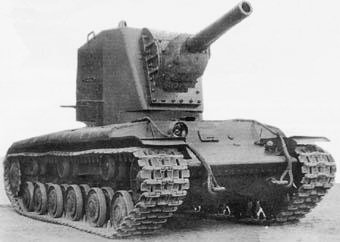
This was the KV-1 (Klim Voroshilov) which mounted a 76.2mm gun. Its sister variant, the KV-2, although more unwieldly, did have a 15cm gun.
KV-1
KV-2
[...]
The appearance of the 34-ton T-34 caused much consternation to the German Panzerwaffe. Developed in relative secrecy six years before, its 76mm gus was the largest armament (apart from the 15cm KV-2) then mounted. Its 60% sloping armour was revolutionary in terms of the increased armoured protection it offered against flat trajectory anti-tank shells, which often simply ricocheted off. Josef Deck, a German artilleryman with Regiment 71 in the central sector, complained that the 37mm standart anti-tank fire 'bounced off them like peas'. Adapting the American Christie suspension system, the T-34, with extra-wide tracks and a powerfull lightweight diesel engine, possessed an enormous relative power-to-weight ratio, conferring superior mobility on the Russian vehicles. Is was to prove the outstanding tank design of the war, and was a formidable adversary, even in the hand of a novice. [...]
Oqueka's battery commander, Oberleutnant Rossman, had a similar experience with the "grey-green colossus", finishing they off firing at the tracks with 20mm cannon.
They moved foward curiously to examine the results of their handiwork and discovered that, apart from cut caterpillar treads and damage to dive and sprocket wheels, there was nothing to explain the abrupt abandonment of the tanks. 'Not until the prisioners were questioned did the riddle become clear', explained Oqueka. The answer lay in the resonant din produced by multiple 20mm strikes os cast steel turrets, which had the effect of transforming them into 'huge bellls'.
'Continuous explosions on the turret had produced a hellish noise which had grown louder from explosion to explosion. The sound had swollen beyond the realms of tolerance and had virtually driven the crews insane'
Oqueka recalled the example of executions of indirected criminals in ancient China. Hapless individuals were incarcerated inside a huge bell which was hammered outside until the unfortunate victim expired. [...]
Kershaw, Robert. War without garlands. Pag. 175-177, 346-347.
Why study Winston Churchill? What makes him relevant in the 21st century? Members of the Churchill family and the Churchill Centre answer the question in this video short.
John S. D. Eisenhower ponders about Hitler's isolation and the "Triumph des Willens", after the assassination attempt of July 20.
[...] Except for his left arm, his slight injuries had healed by now; but he remained weak. He was confined to bed for most of the day by order of his personal physician, leaving it only occasionally to receive important visitors.
This confinement was the culmination of Hitler's progressive removal from a life that had once almost completely public. The withdraw actually began soon after the coming of war. After 1940 he made fewer and fewer appearances, leaving the speechmaking largely to Josef Goebbels. Preoccupied with the details of the conduct of military operations, he saw only the highest officials. Now, at Rastenburg, the process was complete. The Wolf did not leave his lair, and his life had narrowed down to the manipulation of symbols on a map, representations that progressively were less associated with units made up of human beings. Reality was rapidly being replaced by a sort of dream.
[...]
After the attempt on Hitler's life on July 20, of course, the situation was greatly exacerbated. Now bot the field marshals or the commanding generals of the Heer of the officers of the General Staff Corps could be entrusted with strategic operations. What had been dislike of the officer class turned into bitter distrust. Only to associates of proven loyalty such as Jodl and Keitel were Hitler's plans revealed, and to them only gradually.
By the summer of 1944 many surviving German officers of the highest rank had come to believe, or had convinced themselves, that Hitler possessed keen insight into the nature of war and could produce strategic concepts of striking originality. This was, of course, Hitler's view of himself: "A war leader," he said after his Russian victories, "is what I am against my own will. If I apply my mind to military problems, that's because for the moment I know that nobody would succeed better at this than I can".
The fact is that Hitler had a unusual memory, and because of his extensive reading and continual discussion with experts, he had acquired a fund of knowledge in specialized areas often superior to that of the majority of the senior staff officers. Even Generaloberst Heinz Guderian, one of the few who disagreed openly with Hitler on occasion and survived, continued to respect Hitler's military learning.
But it is one thing acquire a fund of information; it is another to apply that tool with common sense, reason, and discipline. Herein lay the basic cleavage between Hitler and the members of the professional German Officer Corps. The qualities of hardheaded reason and thoroughness that the General Staff embodied carried little weight with Hitler. The quality most important to a leader, at least to the top of a great nation, was the mystical quality that he termed "fanaticism."
The conception Hitler had of "fanaticism" has little to do with the English or American definition of the word. Americans would agree that Hitler was a fanatic, but they would not understand what he meant by calling himself so. To Hitler a fanatic was a man who believed in the wonder-working providences of his own will. And the fascinating feature of Hitler's personality, the quality that converted skeptics into followers, was precisely power of will. To this his associates attributed the rise and the eventual triumph of Nazism out of obscurity and disgrace [...]
What made Hitler a "revolutionary" in his thinking was a perversion of German romantic idealism, e. g.: man discovers the truth of existence whenever he molds the outside world into conformity with an idea. To live most deeply is to overcome obstacles, to give shape to the recalcitrant world in which one finds oneself.
This during his rise to power Hitler set himself and his followers objectives that seemed impossible to realize, believing that while premeditated calculations would immediately jump the rails, the impossible could always be reached through the energies generated on one's own side and the general paralysis on the enemy's. Hitler held that we must make a dream work - then it will be as real as a panther tank.
When Hitler's obsession with the "primacy of will" is taken into consideration, many of his attitudes and actions can be better understood. It accounts for his supreme confidence in himself as a military leader and for two of the chief tenets in his military doctrine: (1) "Attack is the best defense," a notion that he praised Clausewitz for expressing, and (2) "Troops should never be made to feel uncertain by withdrawal." If only the will to resist is flexible, most requests for withdrawal are superfluous. The German military found that preparing a precautionary defensive line behind the line of present contact was usually impossible, for Hitler normally refused to allow any commander to look over his shoulder. Commanders were defeatists unless the looked for new forward positions to which to advance.
Einsenhower, John S. D. The battle of the bulge. Pages 106-109.
A word of caution is necessary for the reader who may be unduly impressed by the accounts of controversy and difference of opinion which arose between commanders of the same nationality, officers of different nationalities, and heads of government... When the discussions of the participants in Allied conferences are seen in cold print, without the benefit of the smile which softened a strong argument or the wry shrug which made clear that the debate was for the record, and when there is no transcript of the friendly conversation which followed the official conference, the reader may get the impression that constant argument and heated controversy marked most meetings between Allied leaders... It is inevitable that a study of such discussions will emphasize the disagreements and spell out the problems in reaching accords. The numerous basic decisions which were reached with only minor debate attract less attention...
The success of ... an alliance is to be judged ... not by the amount of heat which may be engendered between the powers in their attempts to find a course of action which will most nearly preserve their individual aims while gaining a common goal, but rather by the degree to which the powers, while frankly working on a basis of self-interest, manage to achieve the one aim for which their forces were brought together. On that basis the Western Powers forged a unit seldom, if ever, achieved in the history of grand alliances. Their commanders, while striving to preserve national identity and gain individual honors for their forces, still waged a victorious war.
Eisenhower, John S. D. The battle of the Bulge. Page 99.
Yet in the case of High Command in France, another factor had to be given careful consideration - feelings of national pride. Pride in country and tradition is not to be discouraged; a soldier cannot fight without it. But in the highest command echelons of nations that have combined their resources to fight a common enemy, this feeling must often be subordinated to the goo of the whole.
This is not easy. Napoleon's detractors have pointed out that his brilliant campaigns were fought largely against coalitions. The coalition between the British and the Americans in World War II was not automatic, It could be injured, conceivably fatally, despite the fact that the two national political leaders were joint signatories of the Atlantic Charter and despite the intense admiration that Americans felt for Britain as she stood alone in 1940. For this reason, General Eisenhower ruefully concluded when writing his memories in 1948, the concealment of projected command arrangements was a mistake,
Eisenhower, John S. D. The battle of the Bulge. Page 66.
Never in history was there a coalition like that of our enemies, composed of such heterogeneous elements with such divergent aims... Even now these states are at loggerheads, and, if we can deliver a few more heavy blows, then this artificially bolstered common front may suddenly collapse with a gigantic clap of thunder.
Adolf Hitler
(upon the ordering the attack through the Ardennes)
Sobre a necessidade de conduzir a economia de guerra, Churchill instrui o Lord President of the Council:
While the Import and Production Executives necessarily are concerned with the pratical handling of the business committed to them, it is essential that the larger issues of economic policy should be dealt with by your committee, and primarily by you. This is in accordance with the drift of well-informed public opinion. You should summon economists like Keynes to give their views to you personally. [...]
Churchill, Winston. The grand alliance. Página 102.
Entre os trabalhos de administrar o Reino Unido durante a guerra, ou conduzir operações militares, Churchill deixa clara a sua preferência em 1941.
[...] Indeed, it was to me almost a relief to turn from these deadly under-tides to the ill-starred but spirited enterprises in the military sphere. How willingly would I have expected a full-scale attempt at invasion for this shapeless, measureless peril, expressed in charts, curves, and statistics!
Churchill, Winston. The grand alliance. Página 101.
Em março de 1941, um momento de difícil decisão chegou: ajudar ou não a Grécia, frente a uma possível e cada vez mais próxima invasão italiana ou alemã? Apesar da Inglaterra ter ajudado a Grécia antes, e mesmo ter assumido um compromisso com a Grécia, a situação estava se deteriorando com a indecisão da Turquia e o desenrolar deste teatro. Pesando tudo isso, em 6 de março de 1941, Churchill escreve ao Mr. Eden - que se encontrava em missão especial no Egito e região -, transmitindo a sua opinião, que no momento, era negativa. Sobre isto, escreve:
After reflecting alone at Chequers on the Sunday night upon the Chiefs of Staff paper and the trend of discussion in the War Cabinet that morning I sent the following message to Mr. Eden, who had now left Athens for Cairo. This certainly struck a different note on my part. But I take full responsibility for the eventual decision, because I am sure I could have stopped it all if I had been convinced. Its so much easier to stop than to do.
Churchill, Winston, The grand alliance. Página 90.
A repentina chegada de Rudolph Hess na Escócia causou grandes desconfianças na Rússia, fazendo-os indagar sobre a possibilidade de um pacto entre a Inglaterra e a Alemanha para invadir a Rússia. Abaixo, Churchill descreve uma conversa que teve com Stalin, três anos depois da chegada de Hess.
Considering how closely Hess was knit to Hitler, it is surprising that he did not know of, or that if he knew he did not disclose, the impeding attack on Russia, for which such vast preparations were being made. The Soviet Government were deeply intrigued by the Hess episode, and they wove many distorted theories around it. Three years late when I was in Moscow on my second visit I realised the fascination which this topic had for Stalin. He asked me at the dinner table what was the truth about the Hess mission. I said shortly what I have written here. I had the feeling that he believed there had been some deep negotiation or plot for Germany and Britain to act together in the invasion of Russia which had miscarried. Remembering what a wise man he is, I was surprised to find him silly in this point. When the interpreter made it plain that he did not believe what I said, I replied through my interpreter, "When I make a statement of facts within my knowledge I expected it to be accepted." Stalin receveid this somewhat abrupt responde with a genial grin. "There are lots of things that happen even here in Russia which our Secret Service do not necessarily tell me about." I let it go at that.
Churchill, Winston. The grand alliance. Página 49.